A Two-Book Deal & Lessons Learned

An official announcement has been made! An announcement about something I’ve been sitting on for a while. This sums up my literary life: a perpetual sitting on good news, waiting for the time I can “officially” announce its hatching. (I’m not complaining! But think about how uncomfortable it is for the good news, to be sat on for prolonged periods like that!)

And the good news? Here it is, at the top of a weekly roundup for book deals in Publishers Weekly. With a photo of me and everything!

An article from Publishers Weekly, dated January 10, 2025, by John Maher. 

"In a preempt, HarperVia's Alexa Frank took world English rights to two novels by 2023 PEN Translation Prize winner TIffany Tsao from Daniel Lazar at WRiters House for Jayarpiya Vasudevan at Jacaranda Literary Agency. The first title, But Won't I Miss Me, set for spring 2026, is a genre-blending meditation on trauma and motherhood "set in a world of new mothers who face Rebirth – birthing an identical, fitter self who eats the original mother and takes her place – and what unfolds as one mother emerges from the process sickly rather than strong."

And because I’m vain, here’s another screenshot from the Publishers Weekly newsletter that reports on global rights. It’s the Deal of the Week!


A non-writer friend pointed out how confusing the language is to someone outside the industry. So I’ll translate: the publisher HarperVia has bought two novels from me. Alexa Frank is the editor at HarperVia who made the acquisition. Jayapriya Vasudevan is my agent, but she worked with a US agent – “a co-agent” – Daniel Lazar to make the sale. That’s the gist, basically. Apart from the fact that…MY NEXT NOVEL IS COMING OUT IN 2026 (which is actually called But Won’t I Miss Me. Spot the typo in the announcement text. But you know what? I don’t mind!)

Though it doesn’t feel like it, it has been a long time since I’ve had a novel of my own come out! And milestones are as good a time as any to reflect on lessons learned.

  1. Time Moves Fast. It really does. It feels like only yesterday when my last published novel came out, first as Under Your Wings in Australia in 2018, then as The Majesties in the US and UK in 2020. 2020 shouldn’t seem like such a long time ago, but on the publishing treadmill it’s already considered “old,” from the Covid era, which is fast receding into the distance too. Imagine that.

    Funnily enough, it’s not as if I lounged around eating bon-bons after Under Your Wings/The Majesties came out. Apart from being busy raising two tiny children and being depressed, and dealing with all the craziness of the Covid times like everyone else, I translated three books and wrote the manuscript of the third instalment of my Oddfits trilogy (which continues its search for a new home). I came up with the idea for this forthcoming novel But Won’t I Miss Me in early 2019. And felt I didn’t have the time to sit down and write it until the end of 2022, when the Copyright Agency gave me a Create Grant to do so!

    Does this mean I should have done something differently? No, I don’t think so. I don’t think I could have written But Won’t I Miss Me sooner anyway. It took years to digest the experience and gain enough distance from its subject matter – the trauma of early motherhood – for me to write it well. But it does make me realize the importance of not comparing, despite the pressure to do so. It’s easy to look at other writers who are producing a book a year, a book every two years, and feel slow and incompetent by comparison. Some people are fast writers. Some people have more time to devote solely to writing. And some people don’t! It’s okay to go steadily at your own pace.

    Having said that, since this is a two-book deal, I do have to prioritize writing that next novel!

  2. Celebrate every win. Every win. Including announcements. There was a time when I would always be waiting for the “official” good thing to happen. And over time, I realized that the “official” time never came. After I’d sign a contract or a book announcement would happen, I’d think, well, but I’ll wait till the book comes out to really celebrate. And then once the book came out, I would think, well, I’ll wait for the reviews to be really good, or for it to get an award. No, no, no. Best to take the wins you have and recognize them for what they are: WINS.

    I’m SO excited about this two-book deal, and SO excited about But Won’t I Miss Me coming out in 2026!

  3. It takes a village to make a book deal. Or at least a small group of excellent people. A heartfelt thank you to Jacaranda Literary Agency and Jayapriya Vasudevan and Helen Mangham there for always championing and supporting my work. Thank you to our US co-agent, Daniel Lazar, (to whom credit goes for getting a US publisher for The Majesties as well)! Thank you so much to Alexa Frank, editor and fellow literary translator and wordsmith, for acquiring But Won’t I Miss Me and Yet-Unnamed-Next-Book! I’m so excited to be working with her!

    There are many others who deserve thank yous, and they’ll appear in the acknowledgements for the books. If I sound like I won an Emmy or something, it’s because, yeah, well, I’m celebrating every win! 😉

The Novel Leads, I Follow (Part 2): some research about the diasporic Chinese in Asia

In my recentish post about novel research, I warned you to expect more about the diasporic Chinese! If you’ve read my novel, The Majesties, you’ll know that the diasporic Chinese – more specifically, the Chinese in Indonesia – feature in a big way. Being of Chinese-Indonesian heritage myself with strong ties to Chinese-majority Singapore, I do tend to think about the global movements of Chinese people. How did we end up in so many places, I often wonder to myself.

The main focus of my new novel (But Won’t I Miss Me?) is motherhood. But motherhood doesn’t exist in a cultural vacuum. As with The Majesties, I felt most comfortable with having the characters be Chinese-Indonesian, though in a different environment and of a different socioeconomic class. I also wanted to establish a loose parallel between the trauma the protagonist experiences and the trauma of racial violence and prejudice that the Chinese in various countries have endured. In the novel, people can’t understand why the protagonist would want to cling to her old, broken-down self – why not move on?

Similarly, there are characters in the novel who decide they want to leave the racial trauma of their history behind. But is true ‘moving on’ even possible? And what is lost, flattened, erased in the abandonment of one’s full past? Again, the novel is mainly about motherhood, but this question, as it pertains to diasporic Chinese racial identity, is the light muzak playing in the background throughout. Or so I intend.

I ended up reading widely about the Chinese in a few different Asian countries. The novel is by no means heavy in historical detail, but there are bits here and there – a scrap of fabric, a bit of ribbon, woven into the work entire.

And what I read was so interesting that I’m sharing some of my resources here – so that you too can go down this rabbit hole, if you choose.

The Chinese in India: Internment

A book cover with a black-and-white photograph of a Chinese family on it. The book title reads in green, "the Deoliwalllahs."

I read The Deoliwallahs by Joy Ma and Dilip D’Souza in my agent’s flat in Bangalore, where she kindly let me hang out for a week after the Jaipur Literature Festival. In the wake of the border war between China and India in 1962, three thousand Chinese-Indians were rounded up and sent to desert internment camps in Deoli, Rajasthan because they were deemed a national security threat. A portion of them were repatriated to China, where they had never actually themselves stepped foot, having lived in India all their lives. The Deoliwallahs recounts the traumatic experiences of several survivors – their painful memories and lasting scars.

An excerpt:

After about five days at the Guwahati jail, they were taken to the railway station. Ying Sheng remembers the huge clouds of flies that swarmed around the Guwahati railway station. With the toilets overwhelmed, people were urinating on the railway tracks, attracting flies. It is a dark memory that has stayed with him for all these years.

The journey to Rajasthan seemed endless. Besides looking out of the window and listening to all the worried talk of the adults, there was nothing to do. The train would stop outside stations so the cooks could prepare meals for them on clay stoves set up on the side of the tracks.

At one such stop, the passengers were not prepared for what happened. A group of 150-200 villagers gathered, holding chappals in their hands, shouting at them to go back to China. The crowd started throwing stones at the train. Ying Sheng and the others rushed to shut the windows.

The Chinese in New Guinea: Abandoned

Next, I endeavoured to find out more about the Chinese in colonial New Guinea. I’d been wanting to learn more about this for a long time, having discovered that a good portion of my friends and acquaintances here in Sydney whom I’d known as “Chinese-Australian” were actually from Chinese families who’d migrated from New Guinea (now Papua New Guinea) after WWII. (It felt a bit like discovering secret long-lost cousins, since Indonesia and PNG are next-door neighbours.)

I read several articles, scholarly and from the news, among them this SBS article and this journal article by Peter Cahill on the Chinese in Rabaul from 1921-1942. (Pro tip: it costs nothing to create a JSTOR account and you can access 100 articles per month for free.)

From the SBS article (which features an interview with Cahill too):

‘[The Chinese] were needed as labourers but not wanted because of the colour bar … Australia inherited them but they weren’t a welcome inheritance because the Germans were sent back to Germany, and the Chinese stayed on and the Australians scratched their heads and said what are we going to do with this lot.’

The result of this racism was that, ahead of the Japanese invasion of Rabaul, New Guinea, European women and children were evacuated, but none of the Chinese. Evacuation of the entire non-native population (European and Chinese) was in fact possible, but the ships were used for copra instead. Official approval for their use in evacuating civilians came too late, after the ships had been bombed.

The Chinese in Vietnam: Discrimination

I’d been excited about reading the novel Chinatown by Thuận (translated from Vietnamese by Nguyễn An Lý) for a while. Now seemed like the ideal time. (And it was so good! I highly recommend!)

The protagonist’s husband, who leaves her one day never to come back, is ethnic Chinese. And the stigma he bears because of it is mentioned frequently.

In doing further research, I came across an anthropology dissertation by LiAnne Sandra Yu about the persecution of the ethnic Chinese (Hoa) community in Vietnam during the late 1970s and 1980s (and their subsequent ‘re-emergence’). Post-1975, many areas where the Hoa were dominant were branded ‘capitalist’, so the Hoa themselves were tarred with this brush. Chinese-language schools and newspapers were shut down and many Hoa were denied jobs and entry to schools. (Similar things happened to the Chinese in Indonesia after 1965.) Yu gets to know many elderly Hoa who experienced this discrimination firsthand and she describes what they faced.

From Yu’s dissertation:

Mr. Cai was a Chinese language teacher in Cholon before 1975. He taught traditional Chinese poetry as well as philosophy and literature. After the Communist takeover, he was arrested in 1978 on charges of fostering Chinese nationalism among his students. Cai adamantly argues that he was only teaching Chinese literature – and was not at all interested in politics. He was jailed for a year, and then eventually put into a labor camp in the countryside. Released in 1986, he believes his activities are still watched and his phone is being tapped. The police come to his home every few months to question him about his activities.

Not included above: all the reading I did about the Chinese community in Medan, where part of the book is set. I also travelled to Medan in order to get a better sense of the atmosphere and history there.

‘Why Medan?’ people kept asking me.

‘My maternal grandfather grew up there,’ I’d reply.

To be continued…

The Novel Leads, I Follow: Electricity, Efficiency, Motherhood

At the end of last year, I received a Copyright Agency grant to write my next standalone novel, But Won’t I Miss Me? – a philosophical speculative fiction work that is set in a society where women who give birth to children also give birth to a new version of themselves. I’ve been writing from Singapore, where my husband, children, and I have relocated for all of 2023.

The wonderful/maddening thing about being former academic is that I tend to do a lot of research while I write. I don’t view it so much as a choice but an obligation. And although it means I can get ‘bogged down’, it also gives me a chance to marinate and absorb the information I discover.

This book is set in an alternative reality where women undergo a natural process called ‘rebirth’ when they give birth to a child (i.e. they give birth to a new version of themselves that replaces the old self). But it is also an alternative reality in other respects: a world where strict legislation regarding environmental sustainability has been in force since the early 2000s. This has resulted in a whole host of ways in which the world of the novel diverges from ours: meat is an expensive luxury good, as are private vehicles; thanks to technological breakthroughs in the area of electricity, inefficient AC (Alternating Current) grids have been replaced with ones that supply low-voltage DC (Direct Current); the internet was nipped in the bud and smartphones never became a thing (fun fact: the carbon footprint of the internet is sizeable and growing; and mining the rare earth elements required for modern digital tech does significant environmental damage as well).

In short, life in the novel is much lower tech and more spartan – at least for the majority of people who can’t afford the expensive tech and goods to make their lives more convenient and comfortable. In this parallel world, the protagonist of the novel works as someone who repairs old AC-powered appliances and machines and makes them compatible with the new low-voltage DC grid.

Research for this novel led me not only to do a lot of reading on electricity and electrical systems. It also led me to take a day-long electrical appliance repair course with a wonderful community org in Singapore called Repair Kopitiam. They encourage people to fix their things rather than throw them away. They hold meetups at various sites where people can bring their items to volunteer coaches who help repair them on the spot. And they run day-long handyman courses and more sustained repair-coach training courses where people can learn the skills to fix things themselves and help others fix things as well.

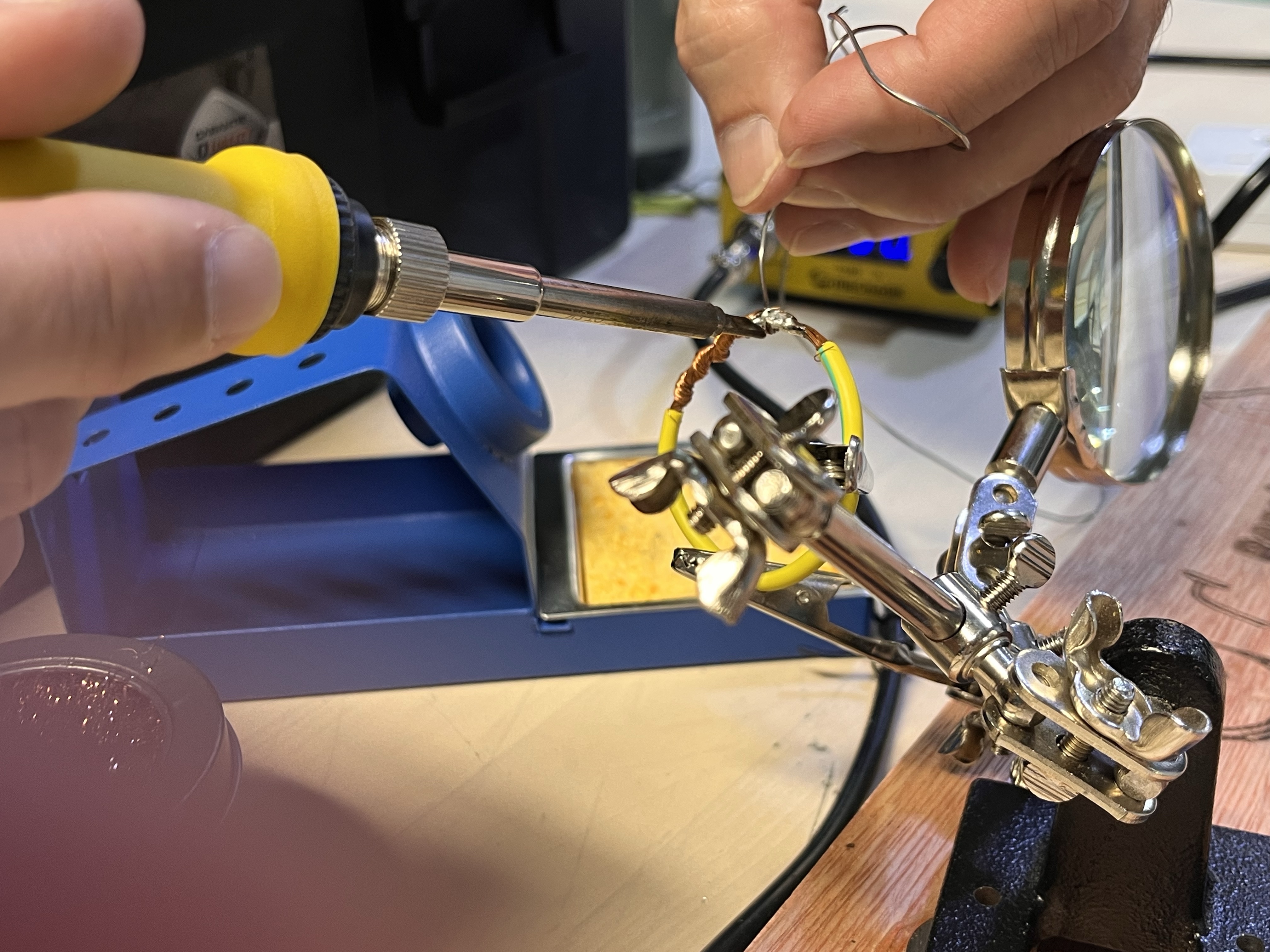
Here are some photos from the course I took on electrical appliance repair. Most of the coaches were older people, as were most of the students. We learned basic principles, important safety information, and got to practice using a multimeter, rewiring a plug, and soldering. Ironically, the course started late because of a building-wide power outage!

Why conceive of such a setting for the novel? And such a profession for my protagonist? Especially for a novel that, on the face of things, deals with pregnancy and motherhood?

The answer is: I wanted this issue of ‘inefficiency’ versus ‘efficiency’; of ‘economical’ versus ‘wasteful’ to be woven throughout the novel. As someone for whom motherhood was a difficult time, physically, mentally, and spiritually speaking, I want the novel to consider how mothers in modern society are expected to perform at inhuman standards of efficiency and perfection. In this world I’m creating, where new mothers are ‘reborn’ and thus ‘renewed’ biologically, such efficiency and perfection comes naturally. But the result is a society where there is no quarter given for a mother whose biological renewal goes wrong.

Much to write and think about! In the meantime, here is a list of interesting reads/videos that I’ve come across in the course of processing motherhood and electrical efficiency:

  • This paper from the International Electrotechnical Commission website on LVDC (Low Voltage Direct Current
  • This YouTube video from KEMET electronics on the difference between AC and DC
  • How to fix a toaster
  • The Cultural Contradictions of Motherhood by Sharon Hays (Yale University Press, 1998). My historian friend Zhou Taomo, who is also a mother of small children, recommended it. I ended up highlighting so much of it when it coincided with my own feelings and experiences. Even though I’m not sure I entirely agree with the conclusion, and even though it was written in the 1990s, I think it still does an accurate job of articulating and documenting the immense and intense pressures “modern” mothers feel.

There’s a third thread I’m weaving into this novel as well: the state of being diasporic Chinese. More on this in a post to come.

A Preview of Oddfits 3: a.k.a. The Disordered Spring

Good day to you, handful of readers of this blog! I would like to present, proudly, an excerpt of the manuscript of Book 3 of the Oddfits trilogy…all of which is still looking for its new home. (Long story. I’m a bit tired of recounting it. But I have to say, I am still so proud of all three books, for which I hope my agent will find a home someday!)

The following is from a chapter early on in the book. Please enjoy! (said Tiff, trying not to feel secretly despairing that it’s been almost a year since she finished the manuscript for this third book and is still seeking a home for the whole trilogy, even though she is a published author so one would think this would be easier, and even though she’s a prize-winning translator, so, really, her ego should be wonderfully plump, but there you have it.)

From Chapter 5 of The Disordered Spring (forthcoming, I’m sure)

Murgatroyd couldn’t afford most things these days, so the one thing he genuinely couldn’t afford was to be late for work. Especially since he was planning to ask his new boss for more hours. He sprinted past Melt My Butter Café, rounded The Fattened Calf steakhouse on the corner, and shot up the stairs two at a time, before scurrying quietly past his former place of employment—The Obese Mouse—into his new one, Pasteural. The professional hedge-trimmers that saw to the semi-weekly upkeep of the topiary signage out front were just finishing up. Murgatroyd smiled awkwardly at them as he slowed to a trot and, panting, parted the dense entrance fronds and stepped into the interior.

Preparations for the lunchtime crowd were already in full swing. The dining room floor had just been mown, and the air was heavy with the fragrance of freshly cut grass. The tables and chairs had already been draped in new lawn coverings, and the place settings—wooden dishes, cutlery, and cups of a delicate rough-hewn appearance—were being laid out by Murgatroyd’s co-workers, all of whom he barely knew because he’d only started working there last week.

Murgatroyd had just made it across the main dining room to the staff area in order to change into his waiter’s caftan when a loud gurgling sound made him jump. He turned to see the small pond in the middle of the dining area filling up with blue water. He recalled what Mr. Harry had told him last week when giving him an orientation: the pond water was turned on at 11:30am. Which meant he was half an hour late.

“You’re half an hour late,” confirmed an American-accented voice behind him.

Murgatroyd yelped and turned. It was Harry Jones, the owner of Pasteural, shaking his head in disapproval. If it were possible, his carefully trimmed stubble and rumpled flannel shirt seemed to only augment his severe demeanour.

“Sorry, Mr. Harry,” blurted Murgatroyd. “I promise it won’t happen again.”

Harry stared coldly at Murgatroyd. “Yes, please see that it doesn’t. Not for my sake, but that of our guests. How can you care for them as they deserve if you don’t even arrive on time?”

“Erh, I…can’t?” ventured Murgatroyd timidly. Leaving rhetorical questions unanswered had never been his strong point.

Harry exhaled impatiently. “And another thing. It’s not ‘Mister Harry.’ Just call me Harry. I insist on being approachable.”

“Ah, yes. Sorry. Sorry, Mr. Harry. I mean, Mr. Jones. I mean, Harry. Yes, Harry, sir.”

With a look of withering contempt, Harry waved Murgatroyd away.

In the staff bathroom, as Murgatroyd changed out his T-shirt and Bermuda shorts, he gazed at the toilet bowl and somehow felt it reminded him of his life. The excitement of that morning had afforded him some respite, but now his misery was back—not just a feature of his existence, but the very stuff of which it was made. After all, hadn’t this been what he’d been doing twelve years ago, when Ann had found him and invited him to join the Quest: waiting tables at a fancy restaurant for a not-very-nice boss? And when you thought about it, wasn’t it worse now? Back then, he hadn’t known he was miserable, and therefore, he had believed himself to be content. Back then, he had at least clung to that promise: Something stupendous is waiting for me. Now he was on the other side of that stupendous something—he’d had it and held it. Then it had melted away. There was nothing to hope for anymore, nothing better to look forward to. How he missed exploring. And how he missed Nutmeg and Tremble most of all.

 As he slid his head into the noose of the caftan’s neck, and his arms into its sleeves, he felt a familiar sensation take hold of him, rolling back his shoulders, straightening his spine. It was the transformation that used to come over him every night when he waited tables at L’Abattoir in the Known World. It had been the one thing he had been good at. Truly, nothing had changed.

He strapped on his leather sandals, stowed his clothes and flip-flops in his employee cubbyhole, and glided out to the dining area to join the rest of the staff, newly clad not just in caftan, but elegance and poise. The artificial lake was now full, the tables were all laid, and the daily staff briefing was about to begin.

One of the other waiters tapped Murgatroyd on the shoulder.

“How did you do that?” she whispered enviously.

“Do what?”

“You know. Become not you.”

Harry cleared his throat and his employees fell silent. Murgatroyd remembered what Harry had said to him while hiring him last week: Pasteural is not just a restaurant. It is a life path. It is a religion. I only ask that you serve it with all your heart and soul. Do you think you can do that—give it your whole heart and soul?

Freshly fired from the restaurant next door and bereft of other options, Murgatroyd had had little choice that day but to say yes.

“Good day to you, my fellow shepherds,” Harry began. And here, he stretched out his arms as if he had read somewhere that this was a gesture of warm camaraderie. “Today is a truly momentous occasion for we members of the Pasteural community. Today, Pasteural officially turns nine months old.”

This was greeting by a smattering of obligatory applause and some light woohooing.

“To mark the occasion, Chef Brian has prepared some specials for today’s lunch menu. Chef Brian?”

Chef Brian—an enthusiastic-looking man with dark circles under his eyes—stepped to the fore.  

“Thank you, Mr.—I mean, Harry! Yes, in honour of this momentous occasion, we have a special birthday starter. It’s a pasteurized, virtually uncooked take on chawanmushi, served in a nest of lightly wilted romaine. It’s called, ‘Sans chawan sans mushi.’”

Here, Harry interrupted. “The egg symbolizes birth! Don’t you just adore it?”

Everyone attempted to look enthusiastic as they nodded in response.

“Our special birthday main,” Chef Brian continued, “is a slab of pink chicken-breast ‘sashimi’ coated in a blanched-almond tandoori-spiced crust and drizzled with a mint-yoghurt sauce—pasteurized yogurt, of course.”

Harry frowned. “So, where’s the birthday element? I thought we discussed this.”

A look of panic crossed Chef Brian’s face. “I thought we agreed that an obvious birthday element would be too gauche.”

“Did we? I thought we agreed the opposite.”

There was a long pause. “I…can drizzle the yoghurt sauce in the shape of a figure nine,” Chef Brian offered.

Harry pressed his palms together and raised his fingers to his lips in concern. “Do you think that’s enough?”

 “I…can add a birthday candle.”

Though Harry didn’t smile, he nodded. “Not as subtly symbolic as the birthday starter, but yes, I think that will be sufficient.”

Chef Brian gave a silent sigh of relief.

“Needless to say,” said Harry addressing all the waitstaff, “make sure you know these specials by heart so you can recite them to our guests in an organic, unstudied fashion. And I’ve noticed that some of you have become lax about directing our non-regulars to the informative welcome page in our menu. Please don’t forget. It communicates our ethos, so they can fully understand and appreciate what a truly life-changing experience we’re creating here. Got it?”

Once again, everyone nodded.

“Good. We open in three minutes. Shepherds to your stations!”

Everyone scurried to take their places, except for Harry, who opened the menu to the welcome page and lovingly reread for the umpteenth time the text he himself had so artfully composed to convey his restaurant’s vision:

Welcome to Pasteural!

In the depths of our name, you will find the seed of our ethos, which, like a real seed, is dense and nutrient-rich. Our name is derived from the French word, “pasteur,” which means “shepherd.” It is etymologically related to the English words, “pastor,” pastoral,” “pasture,” all of which derive from the Latin word meaning, “to feed.”

Indeed, we at Pasteural see ourselves as your shepherds—caring for you, tending to you, nurturing you, nourishing you, providing you with the lush green pastures of unique cuisine on which you can graze. You’ve started a new life in the relatively unspoilt natural surroundings of the More Known World. You deserve the food to go with it.

Our name is also inspired by the surname of Louis Pasteur, the father of the modern food sterilization technique known as pasteurization, in which foods are heated at the lowest temperature required to eliminate harmful pathogens without affecting the quality or flavour of the food itself. Here at Pasteural, we use exclusive, state-of-the-art pasteurization technology and techniques (not found anywhere else) to ensure our dishes are safe to consume, yet for all intents and purposes, raw in appearance and taste.

In short, we are pleased to bring you Nature, but without the danger. Bon appétit from my spirit to yours.

Warmly,

Harry Jones

Founder of Pasteural

Harry smiled and retired to his office so he could enjoy surveilling the dining area and kitchen on his security-camera screens. These past few days, he had been especially gratified to watch the new hire at work. The transformation of whatshisname from awkward, uncoordinated individual to dignified, graceful waiter was truly a testament to the naturally nurturing work environment that he, Harry, had created, which no doubt brought out the best in all his employees.

Murgatroyd, on the other hand, knew better. As he draped serviettes across laps and filled wooden goblets with sparkling water, as he rattled off the day’s specials with greater fluency than he ever spoke otherwise, he knew that what he was experiencing was merely an automatic reversion to a slavish state—a time when he had sought hard to please his employer, his best friend, his parents, everyone but himself. But there was nothing to do now, but endure it and collect his desperately needed pay.

“Psst. Mr. Floyd.”

Murgatroyd turned around to see the bespectacled Settlemore employee who had approached them in the tea tent and escorted them to Winston’s office.

“Oh! Erh, hello. Can I—can I help you?” Murgatroyd stammered, thrown momentarily off-balance by the coincidence.

“Yes, if you don’t mind. May I know…is the sparkling water free?”

Murgatroyd shook his head.

At this news, the man winced. “Ah, I should have asked first,” he sighed, peering with new reverence at his goblet.

“Erh…sorry,” said Murgatroyd, not knowing what else to say.

“It’s okay. It’s okay,” said the man, though he sounded as if he were reassuring himself rather than Murgatroyd. “I’m supposed to be splurging. This is my special birthday treat to myself!”

“Oh! Happy birthday…”

“Choon Yong.”

“Ah. Happy birthday, Choon Yong.”

“Thank you!” replied Choon Yong. He proceeded to look expectant, waiting to be asked the obvious follow-up question.

Murgatroyd obliged. “How old are you?”

“Forty!” declared Choon Yong proudly, before his face turned suddenly aghast. Announcing the figure seemed to have unexpectedly deflated his birthday joy.   

“Erh, it’s Pasteural’s birthday too,” said Murgatroyd.

“Really? How old?” asked Choon Yong, attempting to perk up.           

“Nine months.”

Choon Yong frowned. “So…the restaurant celebrates its birthday every month? That doesn’t make sense.”

Murgatroyd shrugged neutrally, even though he had to admit Choon Yong had a point.

“So, Mr. Floyd, if I may ask, what would you recommend as the best dish on the menu? The most worth it, I mean.”

“Do you like sashimi? Our birthday special main course is a chicken-breast sashimi.”

Choon Yong stared at him in horror.

“Or…our practically-steak-tartare is popular.”

“How come ‘practically’?”

“Steak tartare is raw beef and raw egg. But we cook it at a low temperature so that it kills all the germs, but looks and tastes raw.”

Choon Yong repeated his horrified stare. “Is there anything you serve that is more… cooked?”

Murgatroyd felt very sorry for Choon Yong, who had obviously not done sufficient research on his birthday restaurant of choice. “You could try the phaux phở,” he said pointing to the corresponding entry on the menu. “It’s almost like real phở, except there are no noodles. Only blanched bean sprouts. And we serve it lukewarm so you can appreciate the slimy—erh, silky texture of the meat. But the broth is quite good!”

Choon Yong tried to smile. “To be honest, I was hoping for something more…exotic,” he said. “French or something. You know, since it’s my birthday.”

He stared at the menu for several seconds more.

“What about these?” he asked, pointing at the description of the bratwurst. “Do these taste cooked?”

When Murgatroyd shook his head, Choon Yong sighed. “Okay, I will have the faux phở,” he said, passing Murgatroyd his menu, trying his best to smile.

Murgatroyd decided to refrain from asking the question that he might have asked another diner at this juncture—Would you care to order something to start as well? As he went off to the kitchen to convey the order, he couldn’t help but sneak a backward glance. He watched as Choon Yong straightened his back, looked around, and took a deep breath, as if attempting to inhale into his very bones the expensive birthday experience he had decided to gift himself. He observed as Choon Yong took a deliberate sip of sparkling water, and, as if he were tasting a fine wine, swished it around his mouth before swallowing. And his heart sank a little when Choon Yong gazed at the young, attractive, well-dressed couple to his left, clinking flutes of champagne and laughing elegantly. The birthday boy turned his gaze down at his own self, as if freshly and painfully aware that his was a table for one.

As Murgatroyd forced himself to turn away again, something stirred inside him, though he didn’t even register it. And even if he had, he would have mistaken it for sympathy, or pity, or simply one of the many sadnesses that drifted inside him and stung him with their tentacles every now and then. Who could blame him, really? How can someone in constant pain all over be expected to detect the appearance of a new discomfort? No, Murgatroyd was not at fault. Not now, and not the several times prior to this, when what was about to occur had occurred.

And neither was he to blame for the next steps he took, which only exacerbated the problem. He asked the waiter technically assigned to Choon Yong’s table if she wouldn’t mind swapping. When serving Choon Yong one of Pasteural’s signature par-baked dough balls, he selected the most done-looking one in the basket. And when he set the faux phở before Choon Yong, he provided a detailed explanation of how special each ingredient was and how unique Chef Brian’s pasteurization techniques were—to make Choon Yong feel better about spending the equivalent of ten food court meals on a tiny mound of bean sprouts and technically-not-raw meat in tepid broth.

Murgatroyd continued to lavish his waiterly prowess—his only prowess—on Choon Yong, checking up on him more than usual, making conversation, listening to the tragic tale of how Choon Yong’s fiancée had died thirteen years ago, two days before their wedding, and how he had never been “lucky in love” since. He learned that Choon Yong had decided to take a job with Settlemore and relocate to the More Known World after the death of his parents because Singapore was too expensive and he thought he might as well try something new. He learned that Choon Yong now regretting trying something new because the More Known World was turning out to be very expensive as well, but he didn’t have the energy to quit Settlemore and attempt resettling in Singapore again, plus he had used all his savings to pay off his late mother’s gambling debts.

And all the while, Murgatroyd remained unaware of the intensifying chemical reaction that was taking place inside him—or at least, it would have been called “chemical” if it had been within chemistry’s scope to document and describe what was happening. It was perhaps most akin to the experience that an Oddfit underwent when discovering and accessing a new Territory—a sudden tug, followed by a slackening of a string and the contents spilling out; a neatly stacked deck of cards collapsing and spreading outward; a melting of ice.

The other times Murgatroyd had accidentally unfolded someone, the only one who’d seen what he’d done had been him. The first incident had been many years ago—an isolated event, and over time, he had grown to disbelieve it had happened, dismissing it as a fear-induced hallucination. But then, a few years ago, when he’d started waiting tables again to earn money, it had happened again, out of nowhere. He’d set down a plate of wonton noodles in front of a woman, and the next thing he knew, there were two dozen of her, at various ages, asking him for a saucer of pickled green chillies. Again, no one else had noticed, but because he had screamed in terror and called for help in putting her back together, he’d been fired on the spot.

Several months later, it happened again, and Murgatroyd had reacted in the same way. Again, he’d been fired.

The next time, he had tried to pretend that nothing was wrong, but couldn’t help trying to walk around the multiple iterations of the person he had unfolded. He had spilled scalding hot soup all over another diner, which not only got him fired, but resulted in him having to pay the doctor’s bills for the treatment of the resulting burns.

The two times after that had occurred in quick succession, with him successfully pretending that nothing was wrong in the slightest—that is, if staring into space, silent and frozen, could be considered “successful.” This was what had happened at The Obese Mouse, and when Murgatroyd had been called into his boss’s office to be let go, he had also been given a lecture on the ruinous effects of taking drugs.

And now, less than a week later… Not again, thought Murgatroyd, armpits suddenly drenched in sweat. He concentrated on keeping his hands steady as he placed the small steam-pasteurized whole-almond “birthday mound” on the table. He had coaxed the pastry chef to assemble it, saying it was a treat for a friend. The plate landed safely in front of Choon Yong. The candle’s flame flickered, but didn’t go out. Murgatroyd began taking quick deep breaths.

“Wah, thank you, Mr. Floyd,” breathed Choon Yong, his voice trembly, his edges shaky, all his features blurring. Then a baby arm popped out above his left shoulder and he grew an extra head—a teenage one with an acne-studded forehead. Both heads suddenly looked alarmed.

“Erh…sorry to ask, but is it free?” they chorused.

A third head appeared, equally anxious-looking.

“Yes, yes, free,” squeaked Murgatroyd, breathing even faster. He took a step back. “Erh, please enjoy. I’m just going to…erh…the toilet.”

And then something happened that had never happened before. As Choon Yong unfolded, shooting out into an enormous unwieldy dragon’s tail of Choon Yongs, he sent his table flying into the artificial lake, along with Murgatroyd.

“What’s happening???!?” cried the Choon Yongs in unison, swinging across the restaurant floor, flinging chairs and tables and screaming diners in all directions.

Harry came running out of his office just as the Choon Yongs turned to Murgatroyd. “What did you do to me, Mr. Floyd??!?” they exclaimed.

“Murgatroyd, you did this??” yelled Harry.

“You—you can see it too?” sputtered Murgatroyd from the lake.

“Of course, I can see it! It’s destroying the whole restaurant!”

Harry yelped as a Choon Yong in his twenties sideswiped him, sending him sprawling.

“Stop it now!” cried Harry, raising himself on his elbows.

“I can’t!” cried Murgatroyd, trying to scramble out of the lake to the safety of kitchen doorway.

It was then that the ground began to shake.

The screams were deafening. The Choon Yongs, too, began shrieking in terror, a chorus of fear. Murgatroyd crawled under the nearest upright table and squinched his eyes shut.

And then, it was all over. Murgatroyd opened his eyes to see other people slowly emerging from where they had taken shelter. Choon Yong had returned to his singular self and was patting his body, as if to make absolutely sure he was back in one piece. Harry was sitting up, speechless and stunned.

Murgatroyd ran over to him. “A-are you okay, Mr. Har—I mean, Harry?”

Harry turned. He saw that it was Murgatroyd. “Get out,” he shouted.

“I promise it won’t happen again, I’m sor—”

“I said, GET OUT!” Unsteadily, Harry tried to rise to his feet. “And if insurance doesn’t cover this, you will!” he mumbled. “Do I make myself clear?”

Murgatroyd turned paler than he already was. “But I don’t have enough money,” he squeaked.

“I don’t care!” thundered Harry, now fully recovered and wholly irate. “Get out and don’t you ever come back!”

“Yes, sir. I mean, Harry. I’m so sorry. Forgive me,” babbled Murgatroyd before exiting the restaurant.

He ran back inside. “Just getting my things!” he apologised, trotting to the kitchen where he retrieved his clothes and flip flops before heading back out. He changed near the topiary signage amidst the hedges, folded his work uniform and sandals, and left them in a neat little pile. Murgatroyd’s intention was to head straight back to his flat—for where else was he to go?—but just as he was about to leave the mall, standing there, at the threshold between the visibly artificial and the artificially invisible, his legs suddenly developed a wobble, lowering his entire body to the floor. He crawled over to one of the potted plastic plants flanking the exit. Under the shelter of its synthetic leaves, he hugged his knees to his chest and let the magnitude of what had just occurred sink in. He had not only unfolded someone yet again—this time it hadn’t just happened in his head. Everyone had seen it. Everyone had felt it and almost been hurt by it. Furthermore, he had caused an earthquake. He stared down at himself in horror. What’s wrong with me? What have I done? He began to shiver uncontrollably.

Something landed on his shoulders. Something soft. He looked up. To his astonishment, it was Choon Yong—just one of him, no more. He had just draped a navy-blue cardigan over Murgatroyd’s shoulders.

“Sorry, you looked cold,” said Choon Yong, awkwardly, kneeling next to Murgatroyd. “I hope you don’t mind. It’s mine. I wear it at work. The AC is very strong in Settlemore Tower.”

Too astonished to speak, Murgatroyd put his arms through the sleeves and wrapped it around his chest. He stopped shaking. The pair of them remained silent for a while.

“Are…are you okay, Mr. Floyd?” asked Choon Yong at last.

Murgatroyd couldn’t say yes, but he felt bad about saying no. What right did he have not to be okay? If anyone wasn’t okay, it should be the person whose being he had just spread across an entire room—yet who was here, crouching beside him, comforting him instead of vice-versa.

Choon Yong cleared his throat and spoke again. “Erh, Mr. Floyd. If I may, I’d like to say thank you.”

Murgatroyd stared. The words finally came: “Thank you? For what??”

A look of confusion came over Choon Yong’s face. “I’m not sure exactly,” he stammered, “but I feel a lot better now. After you…did that thing.”

Murgatroyd stared even harder. “Come again?”

Choon Yong turned red. “I don’t know why I feel better, but I do,” he insisted, trying to articulate his experience the best he could. “I mean, you were being so kind to me during lunch, and that was nice. But after you…erh…stretched me out and put me back together…” (here his embarrassed blush suddenly bloomed into a joyful flush) “I just feel better. Much better! So, thank you!”

Upon uttering these words, Choon Yong seemed embarrassed anew. “I’ll go now,” he said quickly. “I should get back to work.”

Murgatroyd began to take off the cardigan, but Choon Yong stopped him.

“Please, Mr. Floyd. Keep it. I have another one in my desk drawer.”

Then, Choon Yong hurried away, leaving Murgatroyd even more astonished and confused about what in the worlds he had just done and how.

If only he had known that the answer to “how” was tucked inside his wallet, on a scrap of paper. He had been carrying it around with him for years, that tail-end of a longer missive never found, cherished for sentimental reasons, scrawled by Uncle Yusuf himself as he had drawn his final breath. What he didn’t know was that it was the whole message—an instruction for Murgatroyd to do what he did best:

Love,Uncle Yusuf

In memory of Budi Darma; a snippet of correspondence about old people and old age

I received terrible news on Saturday. Budi Darma, the Indonesian author whose short story collection I recently translated, had passed away. He had been battling with covid for weeks. I had been receiving updates from someone at his publisher (Noura Books) about his condition and had been hopeful because one of the more recent updates said that he was showing some progress, though still had a persistent cough. Then on Saturday morning, I received news that his blood pressure had plummeted and he was unconscious. Worried, I texted an Indonesian writer friend. A few seconds later, she received a text from her own editor at another publisher that Budi Darma was gone. I received further confirmation from someone else that it was true.

The news of his death travelled at lightning speed, as death news does in Indonesia. Within minutes of his passing, official publisher accounts had made posts in his memory. People were sharing tributes on social media. I received a text request from a newspaper reporter for quotes for his obituary. I received another request that I write an obituary, which I turned down, saying sorry, I was too sad. My husband and I had been in the process of driving our kids to a nearby park. He took the kids to the playground and let me sit in the car and grieve. I couldn’t believe the news.

I still can’t. Still in my head were, are, the conversations that we had over email and WhatsApp about my translation of his short-story collection, Orang-orang Bloomington / People From Bloomington. And also the conversational parts of those conversations: his memories from his time in Bloomington, how he was adapting to teaching his students online, the interest he took in my own writing and history (my departure from academia, how I ended up in Australia). Something that gnaws at me in particular was his initial disappointment that the English edition was only coming out in April 2022, not this year. Why so long, he asked over text in April earlier this year. I said Penguin Classics probably wanted to have more time to prepare good marketing and publicity. At the back of both our minds, I believe, were fears of what bad things might happen in the span of twelve months. Budi Darma was just about to turn 84.

There is one conversation we had in particular that has been haunting me – mainly because it was about growing old. And accepting old age and its frailty. And death. I’d like to share it with you.

I also hope that, since our exchange had to do with the elderly characters of People from Bloomington/Orang-orang Bloomington, it will be of interest to those who have read or will read the collection.

The original Indonesian-language exchange follows the English-language version. Excuse both my flawed Indonesian and my hasty English translation.

(Note on the image above: this illustration accompanied the story “Mrs. Elberhart” [“Ny. Elberhart”] in the original 1980 edition of People from Bloomington [Orang-orang Bloomington]. The artist is Susthanto.


From my letter to Budi Darma, on 13 August 2020

. . . Pak Budi, may I ask a question that tends a bit more toward the personal regarding PFB [People from Bloomington]? Apologies in advance if you find it offensive. This isn’t my intent, and if you don’t feel comfortable responding, hopefully you can just forget I asked at all. But, if I may ask: there are many old characters in the stories of PFB: Mrs. Elberhart, Charles Lebourne, Mrs. Ellison, the three old women in The Old Man With No Name, and of course, the eponymous Old Man himself. These days, you aren’t as young as you used to be (this is the case with us all, of course), and not as young as when you wrote the short story collection. What has it been like to re-read the elderly characters you created when you were younger? Sorry again if this is an impolite question. Feel free to ignore it if you don’t feel like answering it.

Warm regards,

Tiffany


From Budi Darma’s reply on 14 August 2020

. . . This is an excellent question and not offensive at all.

Why so many old people in PFB? Because when I was in Bloomington, I enjoyed taking walks, to the point where I had all the streets memorised, including the alleys. Whenever I went walking, I would almost always cross paths with old people. Of these many old people, some were friendly, some were proud, and some didn’t care about me at all, a.k.a. give a damn. There were even old people who would “chase” me to tell me stories. One of them told me that in his younger days he had been a sheriff. With a note of pride, he showed me his sheriff’s badge. There was also someone who told me that in his youth, he was part of a band and had toured various states with his fellow band members. He told me that, one by one, all his friends had died (apologies, Kak Tiffany. If you had met him yourself, you probably would have been struck by the extent to which his story was tinted with morbidity).

I’ve probably already told you about the old people who would shop and such to kill time. They would drive to the supermarket just to buy a single item, go home to rest, then go to another supermarket to buy something else. After resting, they would go out again to yet another supermarket to buy yet another item.

I had the impression that they were torn between wanting to guard their privacy on one hand and feeling lonely on the other.

You used to live in Boston, didn’t you, though perhaps not in the city itself? It seems to me that old people in Boston are similar to old people in Bloomington, except their loneliness mightn’t be as “dire,” perhaps because Boston is such a busy city. But precisely because Boston is a busy city and, as a result, has a higher crime rate, the elderly people of Boston are sometimes “a little suspicious” of people whom they don’t know well.

Now, why are there so many sick people in PFB? One of the reasons is because my host parent was a surgeon. He would invite me over for dinner and tell many stories about his past trips to Indonesia. Before I left for Bloomington, a number of my friends in Indonesia had said, if you ever meet a doctor don’t bring up your health (unless you’re their patient); most doctors won’t like it.

But by coincidence, he offered his services if I ever felt unwell, saying I should call. I did call him, eventually, and he told me to go to the hospital the next day for a check up. The results were fine.

Then, when any of my friends were sick, they would usually ask me to visit them in the hospital. Once, I witnessed a very sorrowful sight indeed. A young woman was checking into the hospital, I don’t know why. The person attending her had prepared a room (what the room number was I don’t recall). The woman tottered, and she began to cry, refusing to take the room because that was the room where “my dad died.”

How do I feel now? I used to think that 70 was sooo old, and now, 70 seems sooo young. I attended a seminar once, in Bukittinggi, West Sumatra, if I’m not mistaken. Sutan Takdir Alisjahbana (the writer of the novel Layar Terkembang) was one of the keynote speakers. Pak Takdir was 70 years old. I thought, wow, Pak Takdir is sooo old.

Then came Pak Takdir’s turn to approach the podium. His body swayed as he spoke. Many people in the audience held their breath. A few began to whisper that someone should stand next to him. Luckily, he was able to finish the presentation of his brilliant thoughts.

It’s like this, Kak Tiffany. To me, ageing is only natural, and as such should be greeted with wholehearted acceptance. I once took a friend older than me to an opthamologist named Dr. Herschel Smith for an eye exam. No one can prevent old age, the doctor said. This doctor passed away a long time ago, but it seems that his polyclinic has grown under the care of his colleagues (you can find pictures of it on the internet).

As such, Kak Tiffany, I seek to accept everything with the appropriate grace. Heh heh.

Regards,

bd


Cuplikan surat saya kepada Pak Budi pada 13 Agustus 2020

. . . Pak Budi, boleh saya tanya satu pertanyaan yang lebih ke arah “personal” tentang OOB. Maaf sebelumnya kalau Pak Budi merasa tersinggung. Ini bukan maskud saya, dan kalau Pak Budi tidak nyaman menjawab, mudah-mudahan pertanyaan ini bisa lenyap saja dari ingatan Pak Budi. Tapi, boleh saya tanya: ada banyak tokoh tua di cerita-cerita OOB – Ny. Elberhart, Charles Lebourne, Ny. Ellison, ketiga perempuan tua di Laki-Laki Tua Tanpa Nama, dan tentu saja, si Laki-Laki Tua sendiri. Sekarang, Pak Budi tidak semuda dulu (sama dengan kita semua sih), dan tidak semuda sewaktu menulis kumcer OOB. Bagaimana pengalaman Pak Budi jika membaca ulang tokoh-tokoh tua yang diciptakan Pak Budi pada waktu Pak Budi lebih muda. Maaf sekali lagi, Pak, kalau pertanyaan ini kurang sopan. Diabaikan saja kalau Pak Budi kurang sudi jawab ya. 

Salam hangat,

Tiffany


Dari balasan Budi Darma pada 14 Agustus 2020

. . . Pertanyaan ini sangat bagus dan sama sekali tidak menyinggung perasaan.

Mengapa banyak orang tua dalam OOB? Karena waktu itu saya mempunyai hobi jalan-jalan, sampai akhirnya saya hapal hampir semua sudut jalan, termasuk gang-gang tikusnya. Selama saya berjalan-jalan, hampir selamanya saya bertemu dengan orang-orang tua. Di antara sekian banyak orang tua itu ada yang ramah, ada yang sombong, ada juga yang tidak pedulian alias cuek. Bahkan, ada juga orang tua yang “mengejar” saya untuk berbagi cerita. Satu di antaranya bercerita bahwa pada masa mudanya dia adalah sheriff. Dengan nada bangga dia tunjukkan bintang sheriffnya. Lalu ada juga yang bercerita bahwa ketika masih muda dulu, dia mempunyai band, dan dengan anggota bandnya mereka merantau ke berbagai negara bagian. Dia bercerita, bahwa satu persatu temannya meninggal (maaf, Kak Tiffany, mungkin Kak Tiffany sangat terpukau kalau bisa bertemu dengan orang ini, sebab ceritanya  diwarnai oleh unsur morbidity).

Mungkin saya sudah bercerita kepada Kak Tiffany mengenai orang-orang tua yang berbelanja antara lain untuk membunuh waktu. Mereka naik mobil ke sebuah supermarket hanya untuk membeli satu item, pulang untuk beristirahat, lalu pergi ke supermarket lain untuk membeli item lain. Setelah beristirahat, mereka keluar lagi ke super market lain untuk membeli item lain.

Ada kesan, bahwa mereka itu “terjepit” antara menjaga privacy di satu pihak, dan rasa kesepian di pihak lain.

Kak Tiffany kan pernah tinggal di Boston, meskipun mungkin tidak di kotanya. Tampaknya orang-orang tua di Boston mirip dengan orang-orang tua di Bloomington, tapi rasa kesepian orang orang tua di Boston tidak “separah” orang-orsng tua di Bloomington, mungkin karena Boston kota yang sangat sibuk. Tetapi, justru karena Boston kota sibuk dassnn karena itu mungkin angka kriminalitasnya lebih tinggi, maka orang-orang tua di Boston kadang-kadang “agak curiga” dengan orang yang belum dikenalnya dengan baik.

Lalu, mengapa dalam OOB banyak orang sakit? Antara lain karena host family saya seorang dokter bedah. Dia pernah mengundang makan malam, dan banyak bercerita mengenai pengalaman kunjungannya ke Indonesia.  Beberapa teman di Indonesia, sebelum saya ke Bloomington, pernah berkata, kalau bertemu dengan dokter janganlah berbicara mengenai kesehatan (kecuali kalau jadi pasiennya), sebab kebanyakan dokter merasa tidak senang.

Tetapi kebetulan, dia menawarkan diri kalau saya merasa tidak enak badan, saya diminta untuk menilpunnya. Akhirnya memang saya menilpun, saya diminta untuk ke rumah sakit keesokan harinya, check kesehatan, hasilnya baik.

Lalu, kalau ada teman sakit, biasanya teman-teman mengajak saya menengok ke rumah sakit. Saya pernah menyaksikan pemandangan yang memancing rasa iba. Ada seorang perempuan muda yang akan masuk ke rumah sakit, entah karena apa. Oleh petugas dia disediakan sebuah kamar (entah nomor berapa). Perempuan ini badannya beroyang-goyang, menangis, menolak keras diberi kamar itu, karena “my dad died” di kamar itu

Bagaimana perasaan saya sekarang? Dulu saya merasa usia 70 tahun itu tuaaa sekali, sekarang, umur 70 tahun rasanya mudaaa sekali. Pada suatu hari ada sebuah seminar, kalau tidak salah ingat di Bukittinggi, Sumatra Barat, Sutan Takdir Alisjahbana (penulis novel Layar Terkembang) menjadi salah satu pembicara kunci. Usia Pak Takdir 70 tahun. Saya pikir, wah, Pak Takdir ini sudah tuaaa sekali.

Tibalah giliran Pak Takdir untuk menuju ke podium. Waktu Pak Takdir berbicara, tubuhnya bergoyang-goyang. Hadirin banyak yang menahan nafas. Beberapa orang  berbisik-bisik supaya Pak Takdir didampingi. Untunglah, Pak Takdir bisa memaparkan pikirannya yang cemerlang sampai tuntas.

Begini, Kak Tiffany, saya menganggap menjadi tua adalah alamiah, dan karena itu diterima saja dengan ikhlas. Saya pernah mengantar teman yang lebih tua daripada saya untuk memeriksakan matanya ke ophthalmologist, Dr. Herschel Smith. Dokter ini bilang, tidak satu orang pun yang bisa mencegah ketuaan. Sudah lama dokter ini meninggal, tapi tampaknya oleh teman-temannya, poliklinik ini dikembangkan menjadi lebih besar (bisa ditengok di internet)

Dengan demikian, Kak Tiffany, semuanya saya terima secara wajar, hehehe

Salam, 

bd