no news is good news, but new news is also good news

The problem with good news is that when it happens, I am so excited about and caught up with experiencing the goodness of the news happening that writing about it afterwards seems a little anti-climactic. Especially if the goodness of the news is producing much to keep one busy with.

Those who follow my goings-on, here and elsewhere, know that there has been a lot of good news that I have been accumulating, which I will list here, partly because lists are satisfying, and partly because they have indeed accumulated and I don’t want to bore you with blow-by-blow details:

  • My novel But Won’t I Miss Me was published in May through June (depending where you are in the world)! It received starred reviews in Shelf Awareness, Booklist, and Library Journal, and has received solid attention and coverage of a solidly good sort. Occasionally, I find out someone has read it and feels really seen, or that their mind has been blown and they are shocked anew at the things women must endure, or that they are impressed at the craft and structure of the novel. Huzzah, I say, and pat myself on the back.
  • Three of my translations of Indonesian writing were published: The Patient by Naomi Midori in May (original title: Pasien); Olenka by Budi Darma in July (original title: Olenka); and Night of a Thousand Hells by Intan Paramaditha (which I co-translated with Stephen J. Epstein) just today or yesterday, depending where you are in the world. I can hardly believe it myself. Where do I find the time? The answer: although they all came out this year, these projects were in the main, done, respectively, in mid-2024; over 2024 and the first months of 2025; and (at least my portion of it, which was my pass through/deep-dive into Stephen’s manuscript) in a crazy-marathon-late-night-every-night-squeeze-translating-into-every-crevice-possible three month period in 2025.
  • In celebration of International Translation Day, Meanjin invited me to write something for them on something related to translation, or translation-adjacent. Thus invited, I wrote a short piece titled The Iceberg of Translation, mulling on how much unseen (submarine) labour and love can go into translating something without it being visible in the final ‘product’, and detailing how much loving labour went into translating Budi Darma’s Olenka for Penguin Classics.
  • It has been pleasing to enjoy the fruits of my labour when I have time to take breaks and stand idle in the orchard, bite into one of them, and let the juice dribble down my chin. Olenka has received good coverage from Publishers Weekly and Words Without Borders, among other outlets. Which leads me to my next list item:
  • Night of a Thousand Hells came out today in the US and Europe. And it has already been named a finalist for the National Book Award for Translated Literature! I am feeling that my mad-translate-every-spare-moment-marathon aforementioned was not for nothing, and Intan, Stephen, and I are high-fiving virtually across the globe (Intan’s now on the US East Coast; Stephen is in New Zealand; and I am in Australia). Let us now spread a picnic blanket beneath a tree, crack open this pomegranate, and feast on the sweet ruby-red crunchy insides. In fact, pomegranates all around!

In my essay for Meanjin above, I note that ‘[r]oughly 10% of an iceberg sits above the waterline, meaning the other 90% goes unseen (at least to us surface-dwellers). Literary translation is not unlike an iceberg: only a small part of the labour involved is visible in the finished copy. The rest is not so apparent – a submerged and hidden base, upon which sits the beautiful blue craggy structure bobbing along up top.’

Similarly, I feel that, in boiling down this year’s major happenings into this list, I have performed something similar. I am not sure this list has had the pleasing or satisfying effect I intended it to have. When all the care and labour and time, time, time that is spent planting a seed, watering and tending it, nurturing it into a sapling, then into a mature tree that produces many individual fruits, and then that fruit is harvested and placed into a basket, and then the contents are put into a press to have the juice squeezed out, to be gulped down in a single thirsty go, then is that satisfying? I’m not so sure.

A Cover, a Conversazione, and More

I find the importance that we place on book covers these days pretty fascinating. I’m as guilty as anyone else. A book with an amazing cover definitely turns my head. Though I’d certainly never buy or borrow a book on the strength of its cover – recommendations from people I know or whose judgment I trust are still what drive the majority of my decisions to read something or not – I’m aware of the little edge that a good cover can give a book. In fact, I was reading an excellent piece on this not very ideal state of affairs, recently, in It’s Nice That, on whether, in this social-media-heavy age, judging a book by its cover has gone too far?

As an author and translator, I feel this state of affairs acutely. I’ve been fortunate enough to have some very marvellous covers grace my own books. The cover for The Majesties was a semi-finalist for Electric Literature’s annual Book Cover of the Year Tournament in 2020. The cover for my translation of Budi Darma’s People from Bloomington was designed by none other than the Tom Gauld. I’ve been in this biz long enough to know the rush you get when your editor reveals the cover to you, and you LOVE. And also what it’s like to open the attachment and regard a book cover design, and think, It’s all right, I guess. Or worse: Oh no.

So when my editor at HarperVia sent me the cover design for my upcoming novel But Won’t I Miss Me, I breathed a tremendous sigh of happiness and relief. It was LOVE at first sight. I opened the email on the Sydney Metro, after dropping my kids off at school, and I broke into such an enormous and sustained grin, the people around me must have thought I’d just received a love letter or something.

Two eerie figures shrouded under a translucent, luminescent sheet.

This is the cover, designed by Stephanie Shafer. Her note on the design will appear in the book itself, but here is a excerpt:

The photograph, with its translucent veil and interior light, suggests both a womb and a shroud. The pink light evokes life and warmth but also danger—flesh turned alien. The goal was to create a cover that feels beautiful but uneasy […]


Turning now from sights to sounds: I was pleased to participate in a series on literary translation for The Critic and Her Publics podcast, hosted by Merve Emre in conjunction with The New York Review of Books, Literary Hub, and the Hawthornden Foundation. This particular series of conversations makes up Season 3 of the podcast, and was released just a few months ago. Here’s the description:

In 1999, twelve distinguished writers gathered at Casa Ecco, a villa on Lake Como, to discuss the art of translation. Twenty-five years later, their ideas are still apt and powerful. Last October, Merve Emre convened a group of translators and publishers at the same villa to return to those ideas and to examine a field at an inflection point.

In this series, you’ll hear from the translators Maureen Freely, Daisy Rockwell, Virginia Jewiss, Jeremy Tiang, and Tiffany Tsao, as well as publishers Adam Levy (Transit Books) and Jacques Testard (Fitzcarraldo Editions).

A small group of men and women, in collage, next to a graphic that reads 'In Translation Como Conversazione'

The podcast is available to listen to on Apple, Spotify, and other venues. My personal favourite moments: talking about the importance of first sentences; Frankenstein’s monster; shame as occupational hazard for a literary translator; and the money aspect (grimmish).


Some other good news, which I’ve known about for some time, but have been unable to share until recently: a co-translation, coming out in August next year! The English-language edition of Intan Paramaditha’s novel Night of a Thousand Hells (Indonesian title: Malam Seribu Jahanam) will be coming out in August next year with Scribe in Australia and Europa Editions in the UK and US, as translated by Stephen J. Epstein and myself. There was an announcement in The Bookseller, but I’d also like to thank my agent, Jayapriya Vasudevan of Jacaranda Literary Agency, who is not mentioned in the article, for representing Stephen’s and my interests as translators.

Stephen has been working with Intan for years, translating into English her short-story collection Apple and Knife and her novel The Wandering. I’ve been cheering them on for a long time, and was pleased to be invited on board to collaborate with them on the English-language edition of Intan’s very fantastic most recent novel. By good luck, Stephen happened to be passing through Sydney for a few hours on his way home to New Zealand, and he, Intan, and I got together for a celebratory lunch the day before the announcement was made. Here we are in Central Station on Gadigal land.

Three people in an enormous, high-ceilinged train station, with a clock suspended from the ceiling.

Somehow, between all the text-wrangling and reading-for-work, I’ve been managing to find time to read for leisure. Recent books include:

Translation is a Mode = Translation is an Anti-neoclonial Mode by Don Mee Choi (A slim genius pamphlet. Brilliant.)

Cannon by Lee Lai (A graphic novel. Inhaled it and felt out of breath. So many feelings.)

Theory and Practice by Michelle de Kretser (A novel. Straightforward and elegant.)

Where Reasons End by Yiyun Li (A novel. Heartbreaking.)

Paya Nie by Ida Fitri (A novel set in Aceh during the conflict – a window into women’s lives and a community, and the hardships they must endure.)

Hope you’re finding time to read for leisure, and pleasure, as well!

A Two-Book Deal & Lessons Learned

An official announcement has been made! An announcement about something I’ve been sitting on for a while. This sums up my literary life: a perpetual sitting on good news, waiting for the time I can “officially” announce its hatching. (I’m not complaining! But think about how uncomfortable it is for the good news, to be sat on for prolonged periods like that!)

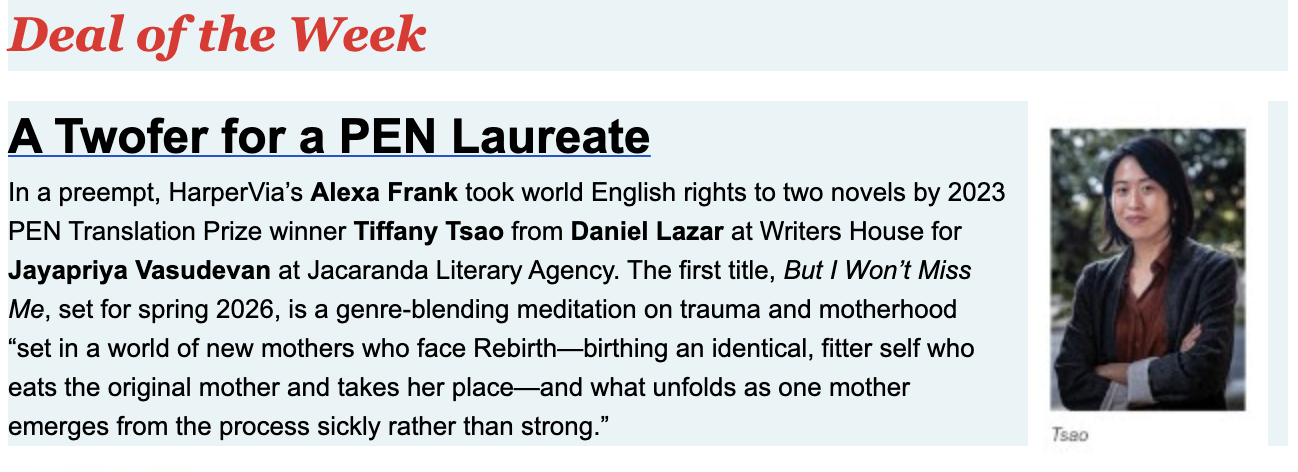
And the good news? Here it is, at the top of a weekly roundup for book deals in Publishers Weekly. With a photo of me and everything!

An article from Publishers Weekly, dated January 10, 2025, by John Maher. 

"In a preempt, HarperVia's Alexa Frank took world English rights to two novels by 2023 PEN Translation Prize winner TIffany Tsao from Daniel Lazar at WRiters House for Jayarpiya Vasudevan at Jacaranda Literary Agency. The first title, But Won't I Miss Me, set for spring 2026, is a genre-blending meditation on trauma and motherhood "set in a world of new mothers who face Rebirth – birthing an identical, fitter self who eats the original mother and takes her place – and what unfolds as one mother emerges from the process sickly rather than strong."

And because I’m vain, here’s another screenshot from the Publishers Weekly newsletter that reports on global rights. It’s the Deal of the Week!


A non-writer friend pointed out how confusing the language is to someone outside the industry. So I’ll translate: the publisher HarperVia has bought two novels from me. Alexa Frank is the editor at HarperVia who made the acquisition. Jayapriya Vasudevan is my agent, but she worked with a US agent – “a co-agent” – Daniel Lazar to make the sale. That’s the gist, basically. Apart from the fact that…MY NEXT NOVEL IS COMING OUT IN 2026 (which is actually called But Won’t I Miss Me. Spot the typo in the announcement text. But you know what? I don’t mind!)

Though it doesn’t feel like it, it has been a long time since I’ve had a novel of my own come out! And milestones are as good a time as any to reflect on lessons learned.

  1. Time Moves Fast. It really does. It feels like only yesterday when my last published novel came out, first as Under Your Wings in Australia in 2018, then as The Majesties in the US and UK in 2020. 2020 shouldn’t seem like such a long time ago, but on the publishing treadmill it’s already considered “old,” from the Covid era, which is fast receding into the distance too. Imagine that.

    Funnily enough, it’s not as if I lounged around eating bon-bons after Under Your Wings/The Majesties came out. Apart from being busy raising two tiny children and being depressed, and dealing with all the craziness of the Covid times like everyone else, I translated three books and wrote the manuscript of the third instalment of my Oddfits trilogy (which continues its search for a new home). I came up with the idea for this forthcoming novel But Won’t I Miss Me in early 2019. And felt I didn’t have the time to sit down and write it until the end of 2022, when the Copyright Agency gave me a Create Grant to do so!

    Does this mean I should have done something differently? No, I don’t think so. I don’t think I could have written But Won’t I Miss Me sooner anyway. It took years to digest the experience and gain enough distance from its subject matter – the trauma of early motherhood – for me to write it well. But it does make me realize the importance of not comparing, despite the pressure to do so. It’s easy to look at other writers who are producing a book a year, a book every two years, and feel slow and incompetent by comparison. Some people are fast writers. Some people have more time to devote solely to writing. And some people don’t! It’s okay to go steadily at your own pace.

    Having said that, since this is a two-book deal, I do have to prioritize writing that next novel!

  2. Celebrate every win. Every win. Including announcements. There was a time when I would always be waiting for the “official” good thing to happen. And over time, I realized that the “official” time never came. After I’d sign a contract or a book announcement would happen, I’d think, well, but I’ll wait till the book comes out to really celebrate. And then once the book came out, I would think, well, I’ll wait for the reviews to be really good, or for it to get an award. No, no, no. Best to take the wins you have and recognize them for what they are: WINS.

    I’m SO excited about this two-book deal, and SO excited about But Won’t I Miss Me coming out in 2026!

  3. It takes a village to make a book deal. Or at least a small group of excellent people. A heartfelt thank you to Jacaranda Literary Agency and Jayapriya Vasudevan and Helen Mangham there for always championing and supporting my work. Thank you to our US co-agent, Daniel Lazar, (to whom credit goes for getting a US publisher for The Majesties as well)! Thank you so much to Alexa Frank, editor and fellow literary translator and wordsmith, for acquiring But Won’t I Miss Me and Yet-Unnamed-Next-Book! I’m so excited to be working with her!

    There are many others who deserve thank yous, and they’ll appear in the acknowledgements for the books. If I sound like I won an Emmy or something, it’s because, yeah, well, I’m celebrating every win! 😉

Late April News

What better way to celebrate writing a 85,500-word document than by writing a blog post? But I want to share some exciting news: I’m finally finished with the manuscript for my most recent standalone novel But Won’t I Miss Me?

Towards the end, it was a marathon and sprint rolled into one: weeks of revising the draft late into the night (I hardly ever work late at night), resuming first thing in the morning and spending all the cracks in between kid-caring and household chores revising, revising, and revising. I’m a heavy reviser too, so this basically involved rewriting pretty much everything. On Saturday night, I sent it off to my agent. Since then, I’ve been incredibly hungry all the time and my body aches, as if I actually ran a marathon (not that I would know because I don’t run marathons). I feel an extraordinary amount of elation and relief. I know that my agent will come back to me with notes soon, and that, still later, I will have to work on it further with the editor at the publisher. But it is still a tremendous feeling to know that it is in as good shape as I can get it by myself. Thank you eternally to the Copyright Agency for giving me a Create Grant so I could write it!

I’ve mentioned the premise for this one before, but in case you missed it: But Won’t I Miss Me? occurs in an alternate-but-close-to-our-reality where having a baby also means birthing an identical but fitter self who will take your place. This bothers the protagonist, but no one understands why.

Frequently Asked Questions:

Don’t you have one unpublished novel manuscript already? Why add to their numbers?

I do! For Oddfans still awaiting the third Oddfits novel – my agent has informed me of some potential bites. But in case it doesn’t work out, I attended a one-day workshop on self-publishing back in February, taught by the lovely Michael Winkler, whose originally self-published Grimmish went on to win awards then secure a publisher because everyone loves a sure thing! I took this workshop so I could be prepared for the challenges that await if I do decide to go rogue and self-publish the Oddfits trilogy.

I know you mainly from your translation work. Tell me what’s going on with that side of things because I am not as interested in your self-authored work.

Okay, more of a demand than a question, but I’ll roll with it. I’m currently translating two Indonesian novels. One is a novella called Pasien (Patient) by Naomi Midori – a thriller that opens with a murdered family (which, by happy coincidence, is also how I chose to open Under Your Wings / The Majesties, so obviously I am the translator-soulmate for this book). This is a job commissioned directly by the Indonesian publisher, Penerbit Haru. The other translation-in-progress is the novel Olenka by Budi Darma. I am honoured to be translating another of his works. Olenka won the S.E.A. Write Award in 1984. It was composed during the same period as Orang-Orang Bloomington (English title: People from Bloomington) and is also set in Indiana, though it is very different, to my mind, in tone and style.

What else are you doing at the moment?

This year, I’m a judge for the translation category of the Singapore Literature Prize, so: Lots of Reading! I’m returning as a judge for the non-fiction category of the Woollahra Digital Literary Prize. I had a late-night chat on Holy Saturday / Easter Eve with Santai Ngobrolin Buku book club in Indonesia. And I was the speaker for Universitas Bunda Mulia’s Stadium Generale this year on “The Challenges of Translating Indonesian Literature.”

Keeping busy! But easier to keep afloat now that the novel manuscript, for now, I hope, is cleared. As my nine-year-old told me today, “Enjoy it while you can.”

The Novel Leads, I Follow: Electricity, Efficiency, Motherhood

At the end of last year, I received a Copyright Agency grant to write my next standalone novel, But Won’t I Miss Me? – a philosophical speculative fiction work that is set in a society where women who give birth to children also give birth to a new version of themselves. I’ve been writing from Singapore, where my husband, children, and I have relocated for all of 2023.

The wonderful/maddening thing about being former academic is that I tend to do a lot of research while I write. I don’t view it so much as a choice but an obligation. And although it means I can get ‘bogged down’, it also gives me a chance to marinate and absorb the information I discover.

This book is set in an alternative reality where women undergo a natural process called ‘rebirth’ when they give birth to a child (i.e. they give birth to a new version of themselves that replaces the old self). But it is also an alternative reality in other respects: a world where strict legislation regarding environmental sustainability has been in force since the early 2000s. This has resulted in a whole host of ways in which the world of the novel diverges from ours: meat is an expensive luxury good, as are private vehicles; thanks to technological breakthroughs in the area of electricity, inefficient AC (Alternating Current) grids have been replaced with ones that supply low-voltage DC (Direct Current); the internet was nipped in the bud and smartphones never became a thing (fun fact: the carbon footprint of the internet is sizeable and growing; and mining the rare earth elements required for modern digital tech does significant environmental damage as well).

In short, life in the novel is much lower tech and more spartan – at least for the majority of people who can’t afford the expensive tech and goods to make their lives more convenient and comfortable. In this parallel world, the protagonist of the novel works as someone who repairs old AC-powered appliances and machines and makes them compatible with the new low-voltage DC grid.

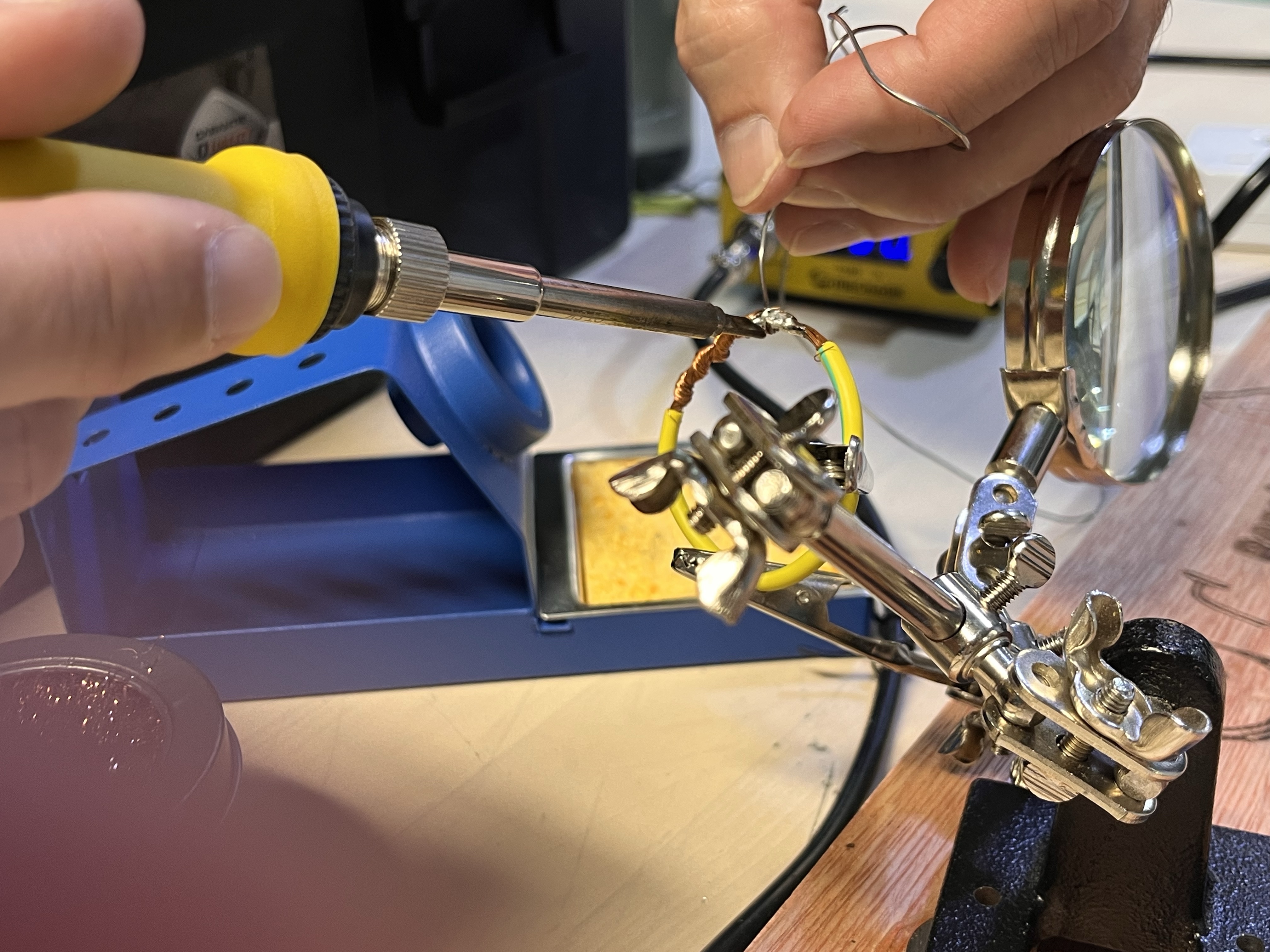
Research for this novel led me not only to do a lot of reading on electricity and electrical systems. It also led me to take a day-long electrical appliance repair course with a wonderful community org in Singapore called Repair Kopitiam. They encourage people to fix their things rather than throw them away. They hold meetups at various sites where people can bring their items to volunteer coaches who help repair them on the spot. And they run day-long handyman courses and more sustained repair-coach training courses where people can learn the skills to fix things themselves and help others fix things as well.

Here are some photos from the course I took on electrical appliance repair. Most of the coaches were older people, as were most of the students. We learned basic principles, important safety information, and got to practice using a multimeter, rewiring a plug, and soldering. Ironically, the course started late because of a building-wide power outage!

Why conceive of such a setting for the novel? And such a profession for my protagonist? Especially for a novel that, on the face of things, deals with pregnancy and motherhood?

The answer is: I wanted this issue of ‘inefficiency’ versus ‘efficiency’; of ‘economical’ versus ‘wasteful’ to be woven throughout the novel. As someone for whom motherhood was a difficult time, physically, mentally, and spiritually speaking, I want the novel to consider how mothers in modern society are expected to perform at inhuman standards of efficiency and perfection. In this world I’m creating, where new mothers are ‘reborn’ and thus ‘renewed’ biologically, such efficiency and perfection comes naturally. But the result is a society where there is no quarter given for a mother whose biological renewal goes wrong.

Much to write and think about! In the meantime, here is a list of interesting reads/videos that I’ve come across in the course of processing motherhood and electrical efficiency:

  • This paper from the International Electrotechnical Commission website on LVDC (Low Voltage Direct Current
  • This YouTube video from KEMET electronics on the difference between AC and DC
  • How to fix a toaster
  • The Cultural Contradictions of Motherhood by Sharon Hays (Yale University Press, 1998). My historian friend Zhou Taomo, who is also a mother of small children, recommended it. I ended up highlighting so much of it when it coincided with my own feelings and experiences. Even though I’m not sure I entirely agree with the conclusion, and even though it was written in the 1990s, I think it still does an accurate job of articulating and documenting the immense and intense pressures “modern” mothers feel.

There’s a third thread I’m weaving into this novel as well: the state of being diasporic Chinese. More on this in a post to come.