A Cover, a Conversazione, and More

I find the importance that we place on book covers these days pretty fascinating. I’m as guilty as anyone else. A book with an amazing cover definitely turns my head. Though I’d certainly never buy or borrow a book on the strength of its cover – recommendations from people I know or whose judgment I trust are still what drive the majority of my decisions to read something or not – I’m aware of the little edge that a good cover can give a book. In fact, I was reading an excellent piece on this not very ideal state of affairs, recently, in It’s Nice That, on whether, in this social-media-heavy age, judging a book by its cover has gone too far?

As an author and translator, I feel this state of affairs acutely. I’ve been fortunate enough to have some very marvellous covers grace my own books. The cover for The Majesties was a semi-finalist for Electric Literature’s annual Book Cover of the Year Tournament in 2020. The cover for my translation of Budi Darma’s People from Bloomington was designed by none other than the Tom Gauld. I’ve been in this biz long enough to know the rush you get when your editor reveals the cover to you, and you LOVE. And also what it’s like to open the attachment and regard a book cover design, and think, It’s all right, I guess. Or worse: Oh no.

So when my editor at HarperVia sent me the cover design for my upcoming novel But Won’t I Miss Me, I breathed a tremendous sigh of happiness and relief. It was LOVE at first sight. I opened the email on the Sydney Metro, after dropping my kids off at school, and I broke into such an enormous and sustained grin, the people around me must have thought I’d just received a love letter or something.

Two eerie figures shrouded under a translucent, luminescent sheet.

This is the cover, designed by Stephanie Shafer. Her note on the design will appear in the book itself, but here is a excerpt:

The photograph, with its translucent veil and interior light, suggests both a womb and a shroud. The pink light evokes life and warmth but also danger—flesh turned alien. The goal was to create a cover that feels beautiful but uneasy […]


Turning now from sights to sounds: I was pleased to participate in a series on literary translation for The Critic and Her Publics podcast, hosted by Merve Emre in conjunction with The New York Review of Books, Literary Hub, and the Hawthornden Foundation. This particular series of conversations makes up Season 3 of the podcast, and was released just a few months ago. Here’s the description:

In 1999, twelve distinguished writers gathered at Casa Ecco, a villa on Lake Como, to discuss the art of translation. Twenty-five years later, their ideas are still apt and powerful. Last October, Merve Emre convened a group of translators and publishers at the same villa to return to those ideas and to examine a field at an inflection point.

In this series, you’ll hear from the translators Maureen Freely, Daisy Rockwell, Virginia Jewiss, Jeremy Tiang, and Tiffany Tsao, as well as publishers Adam Levy (Transit Books) and Jacques Testard (Fitzcarraldo Editions).

A small group of men and women, in collage, next to a graphic that reads 'In Translation Como Conversazione'

The podcast is available to listen to on Apple, Spotify, and other venues. My personal favourite moments: talking about the importance of first sentences; Frankenstein’s monster; shame as occupational hazard for a literary translator; and the money aspect (grimmish).


My recent essay for Griffith Review, “Grave Years and the Undead Woman,” is now available to read for free, in its entirety, on the essays page of my website. This is due to the exclusivity period being up, which means I am now free to publish it here!

It’s been very encouraging to see receive so many positive responses from readers of the essay in GR itself and in its pdf form, most of them mothers – and many who are also writers – who have had similar feelings, experiences, and thoughts.

Text against a pale blue background, headed with the words, 'Grave Years and the Undead Woman' followed by a subheading

Some other good news, which I’ve known about for some time, but have been unable to share until recently: a co-translation, coming out in August next year! The English-language edition of Intan Paramaditha’s novel Night of a Thousand Hells (Indonesian title: Malam Seribu Jahanam) will be coming out in August next year with Scribe in Australia and Europa Editions in the UK and US, as translated by Stephen J. Epstein and myself. There was an announcement in The Bookseller, but I’d also like to thank my agent, Jayapriya Vasudevan of Jacaranda Literary Agency, who is not mentioned in the article, for representing Stephen’s and my interests as translators.

Stephen has been working with Intan for years, translating into English her short-story collection Apple and Knife and her novel The Wandering. I’ve been cheering them on for a long time, and was pleased to be invited on board to collaborate with them on the English-language edition of Intan’s very fantastic most recent novel. By good luck, Stephen happened to be passing through Sydney for a few hours on his way home to New Zealand, and he, Intan, and I got together for a celebratory lunch the day before the announcement was made. Here we are in Central Station on Gadigal land.

Three people in an enormous, high-ceilinged train station, with a clock suspended from the ceiling.

Somehow, between all the text-wrangling and reading-for-work, I’ve been managing to find time to read for leisure. Recent books include:

Translation is a Mode = Translation is an Anti-neoclonial Mode by Don Mee Choi (A slim genius pamphlet. Brilliant.)

Cannon by Lee Lai (A graphic novel. Inhaled it and felt out of breath. So many feelings.)

Theory and Practice by Michelle de Kretser (A novel. Straightforward and elegant.)

Where Reasons End by Yiyun Li (A novel. Heartbreaking.)

Paya Nie by Ida Fitri (A novel set in Aceh during the conflict – a window into women’s lives and a community, and the hardships they must endure.)

Hope you’re finding time to read for leisure, and pleasure, as well!

A Two-Book Deal & Lessons Learned

An official announcement has been made! An announcement about something I’ve been sitting on for a while. This sums up my literary life: a perpetual sitting on good news, waiting for the time I can “officially” announce its hatching. (I’m not complaining! But think about how uncomfortable it is for the good news, to be sat on for prolonged periods like that!)

And the good news? Here it is, at the top of a weekly roundup for book deals in Publishers Weekly. With a photo of me and everything!

An article from Publishers Weekly, dated January 10, 2025, by John Maher. 

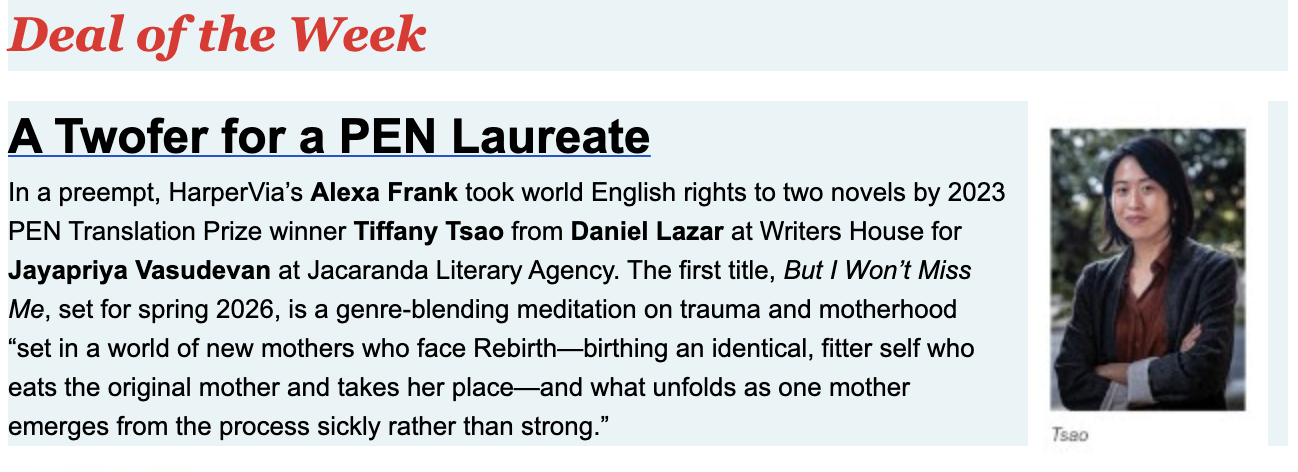
"In a preempt, HarperVia's Alexa Frank took world English rights to two novels by 2023 PEN Translation Prize winner TIffany Tsao from Daniel Lazar at WRiters House for Jayarpiya Vasudevan at Jacaranda Literary Agency. The first title, But Won't I Miss Me, set for spring 2026, is a genre-blending meditation on trauma and motherhood "set in a world of new mothers who face Rebirth – birthing an identical, fitter self who eats the original mother and takes her place – and what unfolds as one mother emerges from the process sickly rather than strong."

And because I’m vain, here’s another screenshot from the Publishers Weekly newsletter that reports on global rights. It’s the Deal of the Week!


A non-writer friend pointed out how confusing the language is to someone outside the industry. So I’ll translate: the publisher HarperVia has bought two novels from me. Alexa Frank is the editor at HarperVia who made the acquisition. Jayapriya Vasudevan is my agent, but she worked with a US agent – “a co-agent” – Daniel Lazar to make the sale. That’s the gist, basically. Apart from the fact that…MY NEXT NOVEL IS COMING OUT IN 2026 (which is actually called But Won’t I Miss Me. Spot the typo in the announcement text. But you know what? I don’t mind!)

Though it doesn’t feel like it, it has been a long time since I’ve had a novel of my own come out! And milestones are as good a time as any to reflect on lessons learned.

  1. Time Moves Fast. It really does. It feels like only yesterday when my last published novel came out, first as Under Your Wings in Australia in 2018, then as The Majesties in the US and UK in 2020. 2020 shouldn’t seem like such a long time ago, but on the publishing treadmill it’s already considered “old,” from the Covid era, which is fast receding into the distance too. Imagine that.

    Funnily enough, it’s not as if I lounged around eating bon-bons after Under Your Wings/The Majesties came out. Apart from being busy raising two tiny children and being depressed, and dealing with all the craziness of the Covid times like everyone else, I translated three books and wrote the manuscript of the third instalment of my Oddfits trilogy (which continues its search for a new home). I came up with the idea for this forthcoming novel But Won’t I Miss Me in early 2019. And felt I didn’t have the time to sit down and write it until the end of 2022, when the Copyright Agency gave me a Create Grant to do so!

    Does this mean I should have done something differently? No, I don’t think so. I don’t think I could have written But Won’t I Miss Me sooner anyway. It took years to digest the experience and gain enough distance from its subject matter – the trauma of early motherhood – for me to write it well. But it does make me realize the importance of not comparing, despite the pressure to do so. It’s easy to look at other writers who are producing a book a year, a book every two years, and feel slow and incompetent by comparison. Some people are fast writers. Some people have more time to devote solely to writing. And some people don’t! It’s okay to go steadily at your own pace.

    Having said that, since this is a two-book deal, I do have to prioritize writing that next novel!

  2. Celebrate every win. Every win. Including announcements. There was a time when I would always be waiting for the “official” good thing to happen. And over time, I realized that the “official” time never came. After I’d sign a contract or a book announcement would happen, I’d think, well, but I’ll wait till the book comes out to really celebrate. And then once the book came out, I would think, well, I’ll wait for the reviews to be really good, or for it to get an award. No, no, no. Best to take the wins you have and recognize them for what they are: WINS.

    I’m SO excited about this two-book deal, and SO excited about But Won’t I Miss Me coming out in 2026!

  3. It takes a village to make a book deal. Or at least a small group of excellent people. A heartfelt thank you to Jacaranda Literary Agency and Jayapriya Vasudevan and Helen Mangham there for always championing and supporting my work. Thank you to our US co-agent, Daniel Lazar, (to whom credit goes for getting a US publisher for The Majesties as well)! Thank you so much to Alexa Frank, editor and fellow literary translator and wordsmith, for acquiring But Won’t I Miss Me and Yet-Unnamed-Next-Book! I’m so excited to be working with her!

    There are many others who deserve thank yous, and they’ll appear in the acknowledgements for the books. If I sound like I won an Emmy or something, it’s because, yeah, well, I’m celebrating every win! 😉

The Novel Leads, I Follow (Part 2): some research about the diasporic Chinese in Asia

In my recentish post about novel research, I warned you to expect more about the diasporic Chinese! If you’ve read my novel, The Majesties, you’ll know that the diasporic Chinese – more specifically, the Chinese in Indonesia – feature in a big way. Being of Chinese-Indonesian heritage myself with strong ties to Chinese-majority Singapore, I do tend to think about the global movements of Chinese people. How did we end up in so many places, I often wonder to myself.

The main focus of my new novel (But Won’t I Miss Me?) is motherhood. But motherhood doesn’t exist in a cultural vacuum. As with The Majesties, I felt most comfortable with having the characters be Chinese-Indonesian, though in a different environment and of a different socioeconomic class. I also wanted to establish a loose parallel between the trauma the protagonist experiences and the trauma of racial violence and prejudice that the Chinese in various countries have endured. In the novel, people can’t understand why the protagonist would want to cling to her old, broken-down self – why not move on?

Similarly, there are characters in the novel who decide they want to leave the racial trauma of their history behind. But is true ‘moving on’ even possible? And what is lost, flattened, erased in the abandonment of one’s full past? Again, the novel is mainly about motherhood, but this question, as it pertains to diasporic Chinese racial identity, is the light muzak playing in the background throughout. Or so I intend.

I ended up reading widely about the Chinese in a few different Asian countries. The novel is by no means heavy in historical detail, but there are bits here and there – a scrap of fabric, a bit of ribbon, woven into the work entire.

And what I read was so interesting that I’m sharing some of my resources here – so that you too can go down this rabbit hole, if you choose.

The Chinese in India: Internment

A book cover with a black-and-white photograph of a Chinese family on it. The book title reads in green, "the Deoliwalllahs."

I read The Deoliwallahs by Joy Ma and Dilip D’Souza in my agent’s flat in Bangalore, where she kindly let me hang out for a week after the Jaipur Literature Festival. In the wake of the border war between China and India in 1962, three thousand Chinese-Indians were rounded up and sent to desert internment camps in Deoli, Rajasthan because they were deemed a national security threat. A portion of them were repatriated to China, where they had never actually themselves stepped foot, having lived in India all their lives. The Deoliwallahs recounts the traumatic experiences of several survivors – their painful memories and lasting scars.

An excerpt:

After about five days at the Guwahati jail, they were taken to the railway station. Ying Sheng remembers the huge clouds of flies that swarmed around the Guwahati railway station. With the toilets overwhelmed, people were urinating on the railway tracks, attracting flies. It is a dark memory that has stayed with him for all these years.

The journey to Rajasthan seemed endless. Besides looking out of the window and listening to all the worried talk of the adults, there was nothing to do. The train would stop outside stations so the cooks could prepare meals for them on clay stoves set up on the side of the tracks.

At one such stop, the passengers were not prepared for what happened. A group of 150-200 villagers gathered, holding chappals in their hands, shouting at them to go back to China. The crowd started throwing stones at the train. Ying Sheng and the others rushed to shut the windows.

The Chinese in New Guinea: Abandoned

Next, I endeavoured to find out more about the Chinese in colonial New Guinea. I’d been wanting to learn more about this for a long time, having discovered that a good portion of my friends and acquaintances here in Sydney whom I’d known as “Chinese-Australian” were actually from Chinese families who’d migrated from New Guinea (now Papua New Guinea) after WWII. (It felt a bit like discovering secret long-lost cousins, since Indonesia and PNG are next-door neighbours.)

I read several articles, scholarly and from the news, among them this SBS article and this journal article by Peter Cahill on the Chinese in Rabaul from 1921-1942. (Pro tip: it costs nothing to create a JSTOR account and you can access 100 articles per month for free.)

From the SBS article (which features an interview with Cahill too):

‘[The Chinese] were needed as labourers but not wanted because of the colour bar … Australia inherited them but they weren’t a welcome inheritance because the Germans were sent back to Germany, and the Chinese stayed on and the Australians scratched their heads and said what are we going to do with this lot.’

The result of this racism was that, ahead of the Japanese invasion of Rabaul, New Guinea, European women and children were evacuated, but none of the Chinese. Evacuation of the entire non-native population (European and Chinese) was in fact possible, but the ships were used for copra instead. Official approval for their use in evacuating civilians came too late, after the ships had been bombed.

The Chinese in Vietnam: Discrimination

I’d been excited about reading the novel Chinatown by Thuận (translated from Vietnamese by Nguyễn An Lý) for a while. Now seemed like the ideal time. (And it was so good! I highly recommend!)

The protagonist’s husband, who leaves her one day never to come back, is ethnic Chinese. And the stigma he bears because of it is mentioned frequently.

In doing further research, I came across an anthropology dissertation by LiAnne Sandra Yu about the persecution of the ethnic Chinese (Hoa) community in Vietnam during the late 1970s and 1980s (and their subsequent ‘re-emergence’). Post-1975, many areas where the Hoa were dominant were branded ‘capitalist’, so the Hoa themselves were tarred with this brush. Chinese-language schools and newspapers were shut down and many Hoa were denied jobs and entry to schools. (Similar things happened to the Chinese in Indonesia after 1965.) Yu gets to know many elderly Hoa who experienced this discrimination firsthand and she describes what they faced.

From Yu’s dissertation:

Mr. Cai was a Chinese language teacher in Cholon before 1975. He taught traditional Chinese poetry as well as philosophy and literature. After the Communist takeover, he was arrested in 1978 on charges of fostering Chinese nationalism among his students. Cai adamantly argues that he was only teaching Chinese literature – and was not at all interested in politics. He was jailed for a year, and then eventually put into a labor camp in the countryside. Released in 1986, he believes his activities are still watched and his phone is being tapped. The police come to his home every few months to question him about his activities.

Not included above: all the reading I did about the Chinese community in Medan, where part of the book is set. I also travelled to Medan in order to get a better sense of the atmosphere and history there.

‘Why Medan?’ people kept asking me.

‘My maternal grandfather grew up there,’ I’d reply.

To be continued…

Late April News

What better way to celebrate writing a 85,500-word document than by writing a blog post? But I want to share some exciting news: I’m finally finished with the manuscript for my most recent standalone novel But Won’t I Miss Me?

Towards the end, it was a marathon and sprint rolled into one: weeks of revising the draft late into the night (I hardly ever work late at night), resuming first thing in the morning and spending all the cracks in between kid-caring and household chores revising, revising, and revising. I’m a heavy reviser too, so this basically involved rewriting pretty much everything. On Saturday night, I sent it off to my agent. Since then, I’ve been incredibly hungry all the time and my body aches, as if I actually ran a marathon (not that I would know because I don’t run marathons). I feel an extraordinary amount of elation and relief. I know that my agent will come back to me with notes soon, and that, still later, I will have to work on it further with the editor at the publisher. But it is still a tremendous feeling to know that it is in as good shape as I can get it by myself. Thank you eternally to the Copyright Agency for giving me a Create Grant so I could write it!

I’ve mentioned the premise for this one before, but in case you missed it: But Won’t I Miss Me? occurs in an alternate-but-close-to-our-reality where having a baby also means birthing an identical but fitter self who will take your place. This bothers the protagonist, but no one understands why.

Frequently Asked Questions:

Don’t you have one unpublished novel manuscript already? Why add to their numbers?

I do! For Oddfans still awaiting the third Oddfits novel – my agent has informed me of some potential bites. But in case it doesn’t work out, I attended a one-day workshop on self-publishing back in February, taught by the lovely Michael Winkler, whose originally self-published Grimmish went on to win awards then secure a publisher because everyone loves a sure thing! I took this workshop so I could be prepared for the challenges that await if I do decide to go rogue and self-publish the Oddfits trilogy.

I know you mainly from your translation work. Tell me what’s going on with that side of things because I am not as interested in your self-authored work.

Okay, more of a demand than a question, but I’ll roll with it. I’m currently translating two Indonesian novels. One is a novella called Pasien (Patient) by Naomi Midori – a thriller that opens with a murdered family (which, by happy coincidence, is also how I chose to open Under Your Wings / The Majesties, so obviously I am the translator-soulmate for this book). This is a job commissioned directly by the Indonesian publisher, Penerbit Haru. The other translation-in-progress is the novel Olenka by Budi Darma. I am honoured to be translating another of his works. Olenka won the S.E.A. Write Award in 1984. It was composed during the same period as Orang-Orang Bloomington (English title: People from Bloomington) and is also set in Indiana, though it is very different, to my mind, in tone and style.

What else are you doing at the moment?

This year, I’m a judge for the translation category of the Singapore Literature Prize, so: Lots of Reading! I’m returning as a judge for the non-fiction category of the Woollahra Digital Literary Prize. I had a late-night chat on Holy Saturday / Easter Eve with Santai Ngobrolin Buku book club in Indonesia. And I was the speaker for Universitas Bunda Mulia’s Stadium Generale this year on “The Challenges of Translating Indonesian Literature.”

Keeping busy! But easier to keep afloat now that the novel manuscript, for now, I hope, is cleared. As my nine-year-old told me today, “Enjoy it while you can.”

The Novel Leads, I Follow: Electricity, Efficiency, Motherhood

At the end of last year, I received a Copyright Agency grant to write my next standalone novel, But Won’t I Miss Me? – a philosophical speculative fiction work that is set in a society where women who give birth to children also give birth to a new version of themselves. I’ve been writing from Singapore, where my husband, children, and I have relocated for all of 2023.

The wonderful/maddening thing about being former academic is that I tend to do a lot of research while I write. I don’t view it so much as a choice but an obligation. And although it means I can get ‘bogged down’, it also gives me a chance to marinate and absorb the information I discover.

This book is set in an alternative reality where women undergo a natural process called ‘rebirth’ when they give birth to a child (i.e. they give birth to a new version of themselves that replaces the old self). But it is also an alternative reality in other respects: a world where strict legislation regarding environmental sustainability has been in force since the early 2000s. This has resulted in a whole host of ways in which the world of the novel diverges from ours: meat is an expensive luxury good, as are private vehicles; thanks to technological breakthroughs in the area of electricity, inefficient AC (Alternating Current) grids have been replaced with ones that supply low-voltage DC (Direct Current); the internet was nipped in the bud and smartphones never became a thing (fun fact: the carbon footprint of the internet is sizeable and growing; and mining the rare earth elements required for modern digital tech does significant environmental damage as well).

In short, life in the novel is much lower tech and more spartan – at least for the majority of people who can’t afford the expensive tech and goods to make their lives more convenient and comfortable. In this parallel world, the protagonist of the novel works as someone who repairs old AC-powered appliances and machines and makes them compatible with the new low-voltage DC grid.

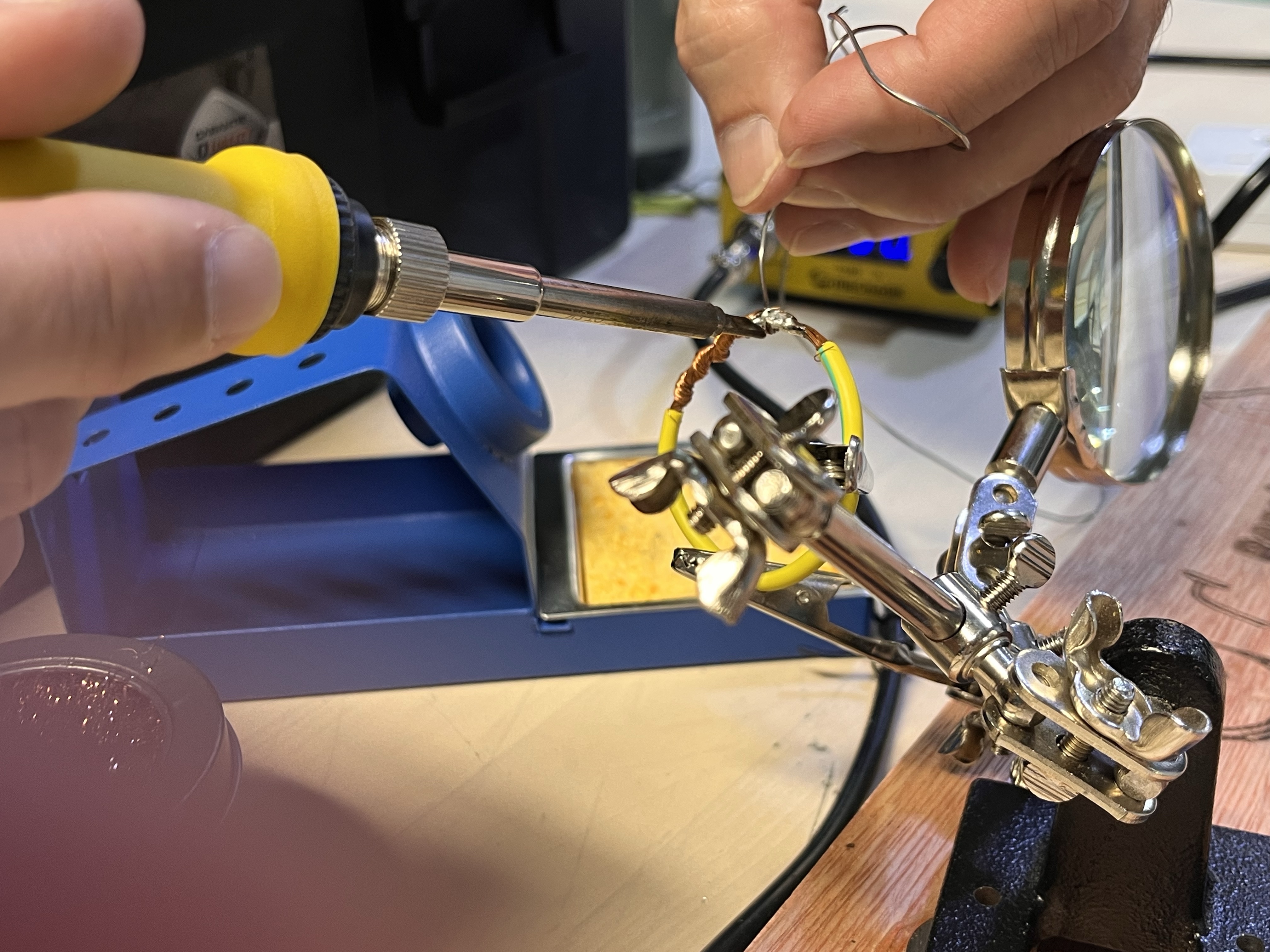
Research for this novel led me not only to do a lot of reading on electricity and electrical systems. It also led me to take a day-long electrical appliance repair course with a wonderful community org in Singapore called Repair Kopitiam. They encourage people to fix their things rather than throw them away. They hold meetups at various sites where people can bring their items to volunteer coaches who help repair them on the spot. And they run day-long handyman courses and more sustained repair-coach training courses where people can learn the skills to fix things themselves and help others fix things as well.

Here are some photos from the course I took on electrical appliance repair. Most of the coaches were older people, as were most of the students. We learned basic principles, important safety information, and got to practice using a multimeter, rewiring a plug, and soldering. Ironically, the course started late because of a building-wide power outage!

Why conceive of such a setting for the novel? And such a profession for my protagonist? Especially for a novel that, on the face of things, deals with pregnancy and motherhood?

The answer is: I wanted this issue of ‘inefficiency’ versus ‘efficiency’; of ‘economical’ versus ‘wasteful’ to be woven throughout the novel. As someone for whom motherhood was a difficult time, physically, mentally, and spiritually speaking, I want the novel to consider how mothers in modern society are expected to perform at inhuman standards of efficiency and perfection. In this world I’m creating, where new mothers are ‘reborn’ and thus ‘renewed’ biologically, such efficiency and perfection comes naturally. But the result is a society where there is no quarter given for a mother whose biological renewal goes wrong.

Much to write and think about! In the meantime, here is a list of interesting reads/videos that I’ve come across in the course of processing motherhood and electrical efficiency:

  • This paper from the International Electrotechnical Commission website on LVDC (Low Voltage Direct Current
  • This YouTube video from KEMET electronics on the difference between AC and DC
  • How to fix a toaster
  • The Cultural Contradictions of Motherhood by Sharon Hays (Yale University Press, 1998). My historian friend Zhou Taomo, who is also a mother of small children, recommended it. I ended up highlighting so much of it when it coincided with my own feelings and experiences. Even though I’m not sure I entirely agree with the conclusion, and even though it was written in the 1990s, I think it still does an accurate job of articulating and documenting the immense and intense pressures “modern” mothers feel.

There’s a third thread I’m weaving into this novel as well: the state of being diasporic Chinese. More on this in a post to come.