The good thing about having a lot of wonderful work projects is that you have a lot of wonderful work!
The bad things about having a lot of work is you have a lot of it.
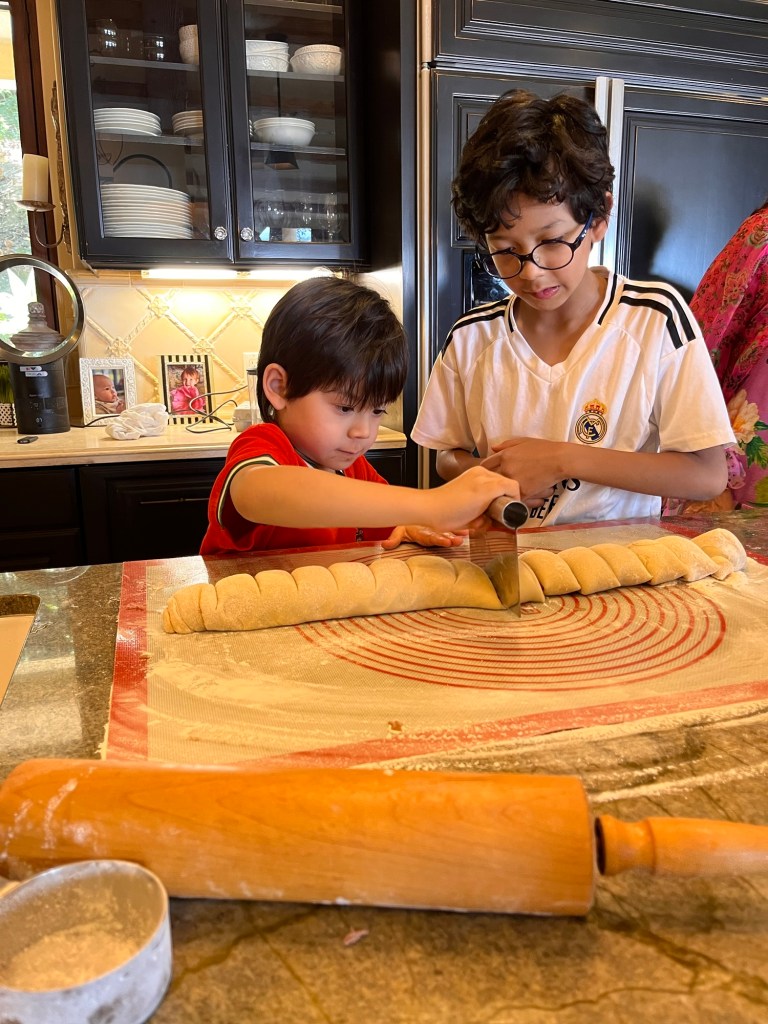
In March, I started a part-time job at the Sydney Review of Books as their Deputy Editor. I’d worked at the SRB before, for a year, in a different capacity, less part-time than this one, and I was excited to rejoin its staff! I’ve enjoyed working there very much, but it’s meant that I’ve had to be much more efficient in managing my time in order to fit in my writing and translation projects, not to mention (to quote the Scooby-Doo villains), those pesky kids (whom I love, I really do). Here is a photo of them making cinnamon rolls with my aunt to show how cute they are.
If you already know what my next novel is about (out in May 2026), you may have suspected that I have complicated feelings about being a mother. I have found motherhood challenging, not because I don’t love my children, but because of society’s onerous expectations of mothers, to the detriment of their personhood and wellbeing. I wrote an essay for Griffith Review recently, on the way modern society sets a mother’s needs in opposition to those of her child’s. I am exceptionally proud of. It has taken me a few years to gain enough distance from being hit by the truck that is motherhood to be able to reflect on it articulately and critically. The essay is titled ‘Grave Years and the Undead Woman’ (and is behind a paywall for the time being, but please contact me at tiffany.a.tsao at gmail dot com if you’re interested in reading it and I’d be happy to email you a copy). Here is a short excerpt:
It strikes me that a living woman need not be bitten by a vampire or die a grisly death to become an undead creature. The moment she conceives, a woman occupies a position not dissimilar to that of vampire Lucy or the kuntilanak. That is, her wants as an individual are set in opposition to the welfare of others, specifically (her) children.
I would hazard to say that all women who have been pregnant or mothers have experienced this opposition, from the twentysomething due to start work next month staring in horror at the two pink lines on her pregnancy test to the fortysomething mother-of-three who is looking forward to returning to work only to discover there’s a fourth child on the way. From the woman six months along who yearns for a sip of wine or a lick of soft-serve ice-cream to the mother of a six-month-old pining for a nice dinner out with friends but feeling guilty about leaving her husband by himself to care for their child and for spending money she isn’t pulling in […]


Even when a woman willingly and lovingly forgoes her time, convenience, comfort and preferences for her child’s sake, the opposition remains. More specifically, as with Lucy and the kuntilanak, the opposition is always cast as between a child’s needs and a woman’s wants. Wants are forgoable, even selfish to indulge, especially if they are in conflict with a small, helpless being’s needs.
And it is undeniable that a woman doesn’t need to go to a restaurant or answer emails when she could be playing with her child. She can do without soft serve – and hummus, and rockmelon (a new addition), and all the other foods on the NSW Government Food Authority website highlighted in red and labelled DON’T EAT. A woman absolutely does not need even the smallest sip of wine. And a woman doesn’t require the freedom of movement that comes from feeding formula to her baby, which allows her to easily leave the baby in the care of someone else. Also, formula is expensive – why buy the formula when you can have the milk for free?
Even if she wants to, a woman needn’t go to work if her family doesn’t need the money. Why not focus on that most important of all jobs: being a mother? (I mean ‘job’ in the loosest sense of the word, because motherhood is its own reward and doesn’t involve any pay.) Childcare is costly anyway, especially in Australia (same logic as above – why buy the childcare when you can have the mother for free?). A woman doesn’t need to not be pregnant, though she may not want to be. A woman may want to lose her cool and yell and tell her child ‘no’, especially when she got only four hours of broken sleep the night before and her child thinks pulling all the clothes out of her drawer and scattering them around the apartment is hilarious. But is such negative behaviour really necessary? As one mum blogger, who has titled her blog Extremely Good Parenting, says, ‘Parenting without negative language like “no”, “don’t” and “stop” is an important part of my every single day.’
Sanctioning or condemning specific choices or behaviors is not my point here. I include these examples to show how the opposition between a woman’s wants and a child’s needs is constantly present in a woman’s life, taking a variety of forms. And, as with vampire Lucy and the kuntilanak, the line between wants and needs is fuzzy, with health authorities, websites, and child-rearing and parenting-advice experts labelling more and more of a mother’s actions and behaviors and deeds and thoughts wants, and hardly ever making use of the needs label, except in the direst circumstances.
At the same time, the list of what a child needs has become exhaustive and tyrannical. These needs may be called ‘best practice’ or ‘developmentally beneficial’ or ‘recommended’ or ‘essential for your child’ – but to knowingly not meet them if you are able to, even at great inconvenience or cost, would be to monstrously and unmaternally prioritise your own desires. (Like vampire Lucy. Like the kuntilanak.)
In other wonderful news pertaining to feeling undead: I’m just coming out of a co-translation project for a novel that had a severe deadline. Probably the severest deadline, given the quality of the translation work expected, I’ve ever had in my translation career. This meant that every waking moment – when I wasn’t working at the SRB or taking care of the kids – was spent working on this translation. It’s a wonderful book and I love the author and my co-translator, but I was having to deal with so many words and so much text on such a continuous basis, that it was beginning to take a severe toll on my brain and mental health. We also had to fight to keep translators’ copyright, which was eventually granted to us (thanks to my agent Jayapriya), but the publisher made it clear that they weren’t particularly happy about it and that it wasn’t their norm.
It feels so good to be pretty much done with the first (most work-intensive) stage of that project. And it made me remember that the vast number of literary translators work under even worse conditions, with ridiculous deadlines, on multiple projects, for low remuneration given the amount of time and thought required to produce quality work, sometimes unable to even retain the copyright for their translation (which must actually be actively signed away, as the copyright for one’s translation by default according to all countries’ copyright laws I’m aware of, actually adheres by default to the translator, the creator of that translation). Speaking for myself, though having a translator’s name on the cover has become a focal talking point for the discussion of translators’ rights, I think this is a superficiality compared to many other things. (But of course, having a translator’s name on the cover may help improve working conditions – it’s harder to mistreat someone with a public profile of some sort than someone who is kept in the shadows and thus can be squashed without anyone noticing.
Finally, a wonderful piece of news that just came in yesterday. My project to translate Grace Tioso’s novel Perkumpulan Anak Luar Nikah (working English-language title: The Born Out of Wedlock Club) has been chosen as one of six winners for the Inaugural PEN Presents x International Booker Prize.

As a Chinese Indonesian writer and translator, the subject matter of this book means a lot to me personally. Grace Tioso’s novel is about the legacy of state-inflicted trauma that Chinese Indonesians must deal with as part of their everyday reality. Humorous and light, but no less deeply touching and insightful, the novel is a gem. The book is represented by my agent Jayapriya Vasudvan at Jacaranda Literary Agency. We hope we will be able to find a publisher soon.


 tiffany tsao