A Cover, a Conversazione, and More

I find the importance that we place on book covers these days pretty fascinating. I’m as guilty as anyone else. A book with an amazing cover definitely turns my head. Though I’d certainly never buy or borrow a book on the strength of its cover – recommendations from people I know or whose judgment I trust are still what drive the majority of my decisions to read something or not – I’m aware of the little edge that a good cover can give a book. In fact, I was reading an excellent piece on this not very ideal state of affairs, recently, in It’s Nice That, on whether, in this social-media-heavy age, judging a book by its cover has gone too far?

As an author and translator, I feel this state of affairs acutely. I’ve been fortunate enough to have some very marvellous covers grace my own books. The cover for The Majesties was a semi-finalist for Electric Literature’s annual Book Cover of the Year Tournament in 2020. The cover for my translation of Budi Darma’s People from Bloomington was designed by none other than the Tom Gauld. I’ve been in this biz long enough to know the rush you get when your editor reveals the cover to you, and you LOVE. And also what it’s like to open the attachment and regard a book cover design, and think, It’s all right, I guess. Or worse: Oh no.

So when my editor at HarperVia sent me the cover design for my upcoming novel But Won’t I Miss Me, I breathed a tremendous sigh of happiness and relief. It was LOVE at first sight. I opened the email on the Sydney Metro, after dropping my kids off at school, and I broke into such an enormous and sustained grin, the people around me must have thought I’d just received a love letter or something.

Two eerie figures shrouded under a translucent, luminescent sheet.

This is the cover, designed by Stephanie Shafer. Her note on the design will appear in the book itself, but here is a excerpt:

The photograph, with its translucent veil and interior light, suggests both a womb and a shroud. The pink light evokes life and warmth but also danger—flesh turned alien. The goal was to create a cover that feels beautiful but uneasy […]


Turning now from sights to sounds: I was pleased to participate in a series on literary translation for The Critic and Her Publics podcast, hosted by Merve Emre in conjunction with The New York Review of Books, Literary Hub, and the Hawthornden Foundation. This particular series of conversations makes up Season 3 of the podcast, and was released just a few months ago. Here’s the description:

In 1999, twelve distinguished writers gathered at Casa Ecco, a villa on Lake Como, to discuss the art of translation. Twenty-five years later, their ideas are still apt and powerful. Last October, Merve Emre convened a group of translators and publishers at the same villa to return to those ideas and to examine a field at an inflection point.

In this series, you’ll hear from the translators Maureen Freely, Daisy Rockwell, Virginia Jewiss, Jeremy Tiang, and Tiffany Tsao, as well as publishers Adam Levy (Transit Books) and Jacques Testard (Fitzcarraldo Editions).

A small group of men and women, in collage, next to a graphic that reads 'In Translation Como Conversazione'

The podcast is available to listen to on Apple, Spotify, and other venues. My personal favourite moments: talking about the importance of first sentences; Frankenstein’s monster; shame as occupational hazard for a literary translator; and the money aspect (grimmish).


My recent essay for Griffith Review, “Grave Years and the Undead Woman,” is now available to read for free, in its entirety, on the essays page of my website. This is due to the exclusivity period being up, which means I am now free to publish it here!

It’s been very encouraging to see receive so many positive responses from readers of the essay in GR itself and in its pdf form, most of them mothers – and many who are also writers – who have had similar feelings, experiences, and thoughts.

Text against a pale blue background, headed with the words, 'Grave Years and the Undead Woman' followed by a subheading

Some other good news, which I’ve known about for some time, but have been unable to share until recently: a co-translation, coming out in August next year! The English-language edition of Intan Paramaditha’s novel Night of a Thousand Hells (Indonesian title: Malam Seribu Jahanam) will be coming out in August next year with Scribe in Australia and Europa Editions in the UK and US, as translated by Stephen J. Epstein and myself. There was an announcement in The Bookseller, but I’d also like to thank my agent, Jayapriya Vasudevan of Jacaranda Literary Agency, who is not mentioned in the article, for representing Stephen’s and my interests as translators.

Stephen has been working with Intan for years, translating into English her short-story collection Apple and Knife and her novel The Wandering. I’ve been cheering them on for a long time, and was pleased to be invited on board to collaborate with them on the English-language edition of Intan’s very fantastic most recent novel. By good luck, Stephen happened to be passing through Sydney for a few hours on his way home to New Zealand, and he, Intan, and I got together for a celebratory lunch the day before the announcement was made. Here we are in Central Station on Gadigal land.

Three people in an enormous, high-ceilinged train station, with a clock suspended from the ceiling.

Somehow, between all the text-wrangling and reading-for-work, I’ve been managing to find time to read for leisure. Recent books include:

Translation is a Mode = Translation is an Anti-neoclonial Mode by Don Mee Choi (A slim genius pamphlet. Brilliant.)

Cannon by Lee Lai (A graphic novel. Inhaled it and felt out of breath. So many feelings.)

Theory and Practice by Michelle de Kretser (A novel. Straightforward and elegant.)

Where Reasons End by Yiyun Li (A novel. Heartbreaking.)

Paya Nie by Ida Fitri (A novel set in Aceh during the conflict – a window into women’s lives and a community, and the hardships they must endure.)

Hope you’re finding time to read for leisure, and pleasure, as well!

The Undead, a Deadline, Gainful Employment, and a Prize Won

The good thing about having a lot of wonderful work projects is that you have a lot of wonderful work!

The bad things about having a lot of work is you have a lot of it.

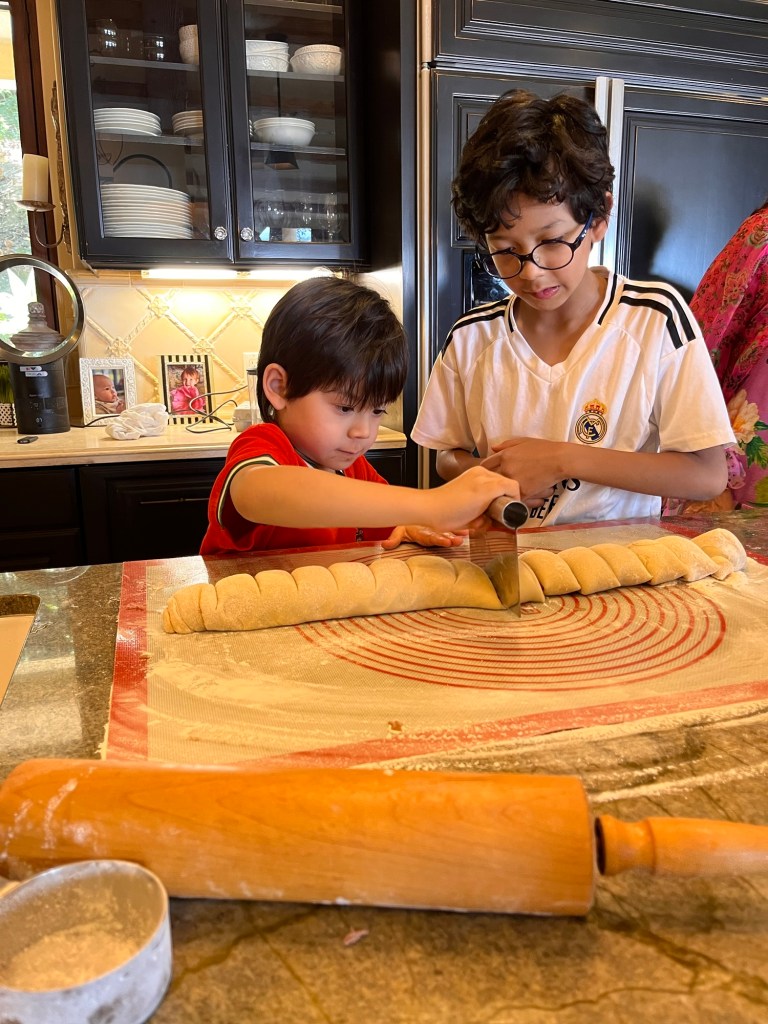
In March, I started a part-time job at the Sydney Review of Books as their Deputy Editor. I’d worked at the SRB before, for a year, in a different capacity, less part-time than this one, and I was excited to rejoin its staff! I’ve enjoyed working there very much, but it’s meant that I’ve had to be much more efficient in managing my time in order to fit in my writing and translation projects, not to mention (to quote the Scooby-Doo villains), those pesky kids (whom I love, I really do). Here is a photo of them making cinnamon rolls with my aunt to show how cute they are.

If you already know what my next novel is about (out in May 2026), you may have suspected that I have complicated feelings about being a mother. I have found motherhood challenging, not because I don’t love my children, but because of society’s onerous expectations of mothers, to the detriment of their personhood and wellbeing. I wrote an essay for Griffith Review recently, on the way modern society sets a mother’s needs in opposition to those of her child’s. I am exceptionally proud of. It has taken me a few years to gain enough distance from being hit by the truck that is motherhood to be able to reflect on it articulately and critically. The essay is titled ‘Grave Years and the Undead Woman’ (and is behind a paywall for the time being, but please contact me at tiffany.a.tsao at gmail dot com if you’re interested in reading it and I’d be happy to email you a copy). Here is a short excerpt:

It strikes me that a living woman need not be bitten by a vampire or die a grisly death to become an undead creature. The moment she conceives, a woman occupies a position not dissimilar to that of vampire Lucy or the kuntilanak. That is, her wants as an individual are set in opposition to the welfare of others, specifically (her) children.

I would hazard to say that all women who have been pregnant or mothers have experienced this opposition, from the twentysomething due to start work next month staring in horror at the two pink lines on her pregnancy test to the fortysomething mother-of-three who is looking forward to returning to work only to discover there’s a fourth child on the way. From the woman six months along who yearns for a sip of wine or a lick of soft-serve ice-cream to the mother of a six-month-old pining for a nice dinner out with friends but feeling guilty about leaving her husband by himself to care for their child and for spending money she isn’t pulling in […]

Even when a woman willingly and lovingly forgoes her time, convenience, comfort and preferences for her child’s sake, the opposition remains. More specifically, as with Lucy and the kuntilanak, the opposition is always cast as between a child’s needs and a woman’s wants. Wants are forgoable, even selfish to indulge, especially if they are in conflict with a small, helpless being’s needs.

And it is undeniable that a woman doesn’t need to go to a restaurant or answer emails when she could be playing with her child. She can do without soft serve – and hummus, and rockmelon (a new addition), and all the other foods on the NSW Government Food Authority website highlighted in red and labelled DON’T EAT. A woman absolutely does not need even the smallest sip of wine. And a woman doesn’t require the freedom of movement that comes from feeding formula to her baby, which allows her to easily leave the baby in the care of someone else. Also, formula is expensive – why buy the formula when you can have the milk for free?

Even if she wants to, a woman needn’t go to work if her family doesn’t need the money. Why not focus on that most important of all jobs: being a mother? (I mean ‘job’ in the loosest sense of the word, because motherhood is its own reward and doesn’t involve any pay.) Childcare is costly anyway, especially in Australia (same logic as above – why buy the childcare when you can have the mother for free?). A woman doesn’t need to not be pregnant, though she may not want to be. A woman may want to lose her cool and yell and tell her child ‘no’, especially when she got only four hours of broken sleep the night before and her child thinks pulling all the clothes out of her drawer and scattering them around the apartment is hilarious. But is such negative behaviour really necessary? As one mum blogger, who has titled her blog Extremely Good Parenting, says, ‘Parenting without negative language like “no”, “don’t” and “stop” is an important part of my every single day.’

Sanctioning or condemning specific choices or behaviors is not my point here. I include these examples to show how the opposition between a woman’s wants and a child’s needs is constantly present in a woman’s life, taking a variety of forms. And, as with vampire Lucy and the kuntilanak, the line between wants and needs is fuzzy, with health authorities, websites, and child-rearing and parenting-advice experts labelling more and more of a mother’s actions and behaviors and deeds and thoughts wants, and hardly ever making use of the needs label, except in the direst circumstances.

At the same time, the list of what a child needs has become exhaustive and tyrannical. These needs may be called ‘best practice’ or ‘developmentally beneficial’ or ‘recommended’ or ‘essential for your child’ – but to knowingly not meet them if you are able to, even at great inconvenience or cost, would be to monstrously and unmaternally prioritise your own desires. (Like vampire Lucy. Like the kuntilanak.)

In other wonderful news pertaining to feeling undead: I’m just coming out of a co-translation project for a novel that had a severe deadline. Probably the severest deadline, given the quality of the translation work expected, I’ve ever had in my translation career. This meant that every waking moment – when I wasn’t working at the SRB or taking care of the kids – was spent working on this translation. It’s a wonderful book and I love the author and my co-translator, but I was having to deal with so many words and so much text on such a continuous basis, that it was beginning to take a severe toll on my brain and mental health. We also had to fight to keep translators’ copyright, which was eventually granted to us (thanks to my agent Jayapriya), but the publisher made it clear that they weren’t particularly happy about it and that it wasn’t their norm.

It feels so good to be pretty much done with the first (most work-intensive) stage of that project. And it made me remember that the vast number of literary translators work under even worse conditions, with ridiculous deadlines, on multiple projects, for low remuneration given the amount of time and thought required to produce quality work, sometimes unable to even retain the copyright for their translation (which must actually be actively signed away, as the copyright for one’s translation by default according to all countries’ copyright laws I’m aware of, actually adheres by default to the translator, the creator of that translation). Speaking for myself, though having a translator’s name on the cover has become a focal talking point for the discussion of translators’ rights, I think this is a superficiality compared to many other things. (But of course, having a translator’s name on the cover may help improve working conditions – it’s harder to mistreat someone with a public profile of some sort than someone who is kept in the shadows and thus can be squashed without anyone noticing.

Finally, a wonderful piece of news that just came in yesterday. My project to translate Grace Tioso’s novel Perkumpulan Anak Luar Nikah (working English-language title: The Born Out of Wedlock Club) has been chosen as one of six winners for the Inaugural PEN Presents x International Booker Prize.

As a Chinese Indonesian writer and translator, the subject matter of this book means a lot to me personally. Grace Tioso’s novel is about the legacy of state-inflicted trauma that Chinese Indonesians must deal with as part of their everyday reality. Humorous and light, but no less deeply touching and insightful, the novel is a gem. The book is represented by my agent Jayapriya Vasudvan at Jacaranda Literary Agency. We hope we will be able to find a publisher soon.

In memory of Budi Darma; a snippet of correspondence about old people and old age

I received terrible news on Saturday. Budi Darma, the Indonesian author whose short story collection I recently translated, had passed away. He had been battling with covid for weeks. I had been receiving updates from someone at his publisher (Noura Books) about his condition and had been hopeful because one of the more recent updates said that he was showing some progress, though still had a persistent cough. Then on Saturday morning, I received news that his blood pressure had plummeted and he was unconscious. Worried, I texted an Indonesian writer friend. A few seconds later, she received a text from her own editor at another publisher that Budi Darma was gone. I received further confirmation from someone else that it was true.

The news of his death travelled at lightning speed, as death news does in Indonesia. Within minutes of his passing, official publisher accounts had made posts in his memory. People were sharing tributes on social media. I received a text request from a newspaper reporter for quotes for his obituary. I received another request that I write an obituary, which I turned down, saying sorry, I was too sad. My husband and I had been in the process of driving our kids to a nearby park. He took the kids to the playground and let me sit in the car and grieve. I couldn’t believe the news.

I still can’t. Still in my head were, are, the conversations that we had over email and WhatsApp about my translation of his short-story collection, Orang-orang Bloomington / People From Bloomington. And also the conversational parts of those conversations: his memories from his time in Bloomington, how he was adapting to teaching his students online, the interest he took in my own writing and history (my departure from academia, how I ended up in Australia). Something that gnaws at me in particular was his initial disappointment that the English edition was only coming out in April 2022, not this year. Why so long, he asked over text in April earlier this year. I said Penguin Classics probably wanted to have more time to prepare good marketing and publicity. At the back of both our minds, I believe, were fears of what bad things might happen in the span of twelve months. Budi Darma was just about to turn 84.

There is one conversation we had in particular that has been haunting me – mainly because it was about growing old. And accepting old age and its frailty. And death. I’d like to share it with you.

I also hope that, since our exchange had to do with the elderly characters of People from Bloomington/Orang-orang Bloomington, it will be of interest to those who have read or will read the collection.

The original Indonesian-language exchange follows the English-language version. Excuse both my flawed Indonesian and my hasty English translation.

(Note on the image above: this illustration accompanied the story “Mrs. Elberhart” [“Ny. Elberhart”] in the original 1980 edition of People from Bloomington [Orang-orang Bloomington]. The artist is Susthanto.


From my letter to Budi Darma, on 13 August 2020

. . . Pak Budi, may I ask a question that tends a bit more toward the personal regarding PFB [People from Bloomington]? Apologies in advance if you find it offensive. This isn’t my intent, and if you don’t feel comfortable responding, hopefully you can just forget I asked at all. But, if I may ask: there are many old characters in the stories of PFB: Mrs. Elberhart, Charles Lebourne, Mrs. Ellison, the three old women in The Old Man With No Name, and of course, the eponymous Old Man himself. These days, you aren’t as young as you used to be (this is the case with us all, of course), and not as young as when you wrote the short story collection. What has it been like to re-read the elderly characters you created when you were younger? Sorry again if this is an impolite question. Feel free to ignore it if you don’t feel like answering it.

Warm regards,

Tiffany


From Budi Darma’s reply on 14 August 2020

. . . This is an excellent question and not offensive at all.

Why so many old people in PFB? Because when I was in Bloomington, I enjoyed taking walks, to the point where I had all the streets memorised, including the alleys. Whenever I went walking, I would almost always cross paths with old people. Of these many old people, some were friendly, some were proud, and some didn’t care about me at all, a.k.a. give a damn. There were even old people who would “chase” me to tell me stories. One of them told me that in his younger days he had been a sheriff. With a note of pride, he showed me his sheriff’s badge. There was also someone who told me that in his youth, he was part of a band and had toured various states with his fellow band members. He told me that, one by one, all his friends had died (apologies, Kak Tiffany. If you had met him yourself, you probably would have been struck by the extent to which his story was tinted with morbidity).

I’ve probably already told you about the old people who would shop and such to kill time. They would drive to the supermarket just to buy a single item, go home to rest, then go to another supermarket to buy something else. After resting, they would go out again to yet another supermarket to buy yet another item.

I had the impression that they were torn between wanting to guard their privacy on one hand and feeling lonely on the other.

You used to live in Boston, didn’t you, though perhaps not in the city itself? It seems to me that old people in Boston are similar to old people in Bloomington, except their loneliness mightn’t be as “dire,” perhaps because Boston is such a busy city. But precisely because Boston is a busy city and, as a result, has a higher crime rate, the elderly people of Boston are sometimes “a little suspicious” of people whom they don’t know well.

Now, why are there so many sick people in PFB? One of the reasons is because my host parent was a surgeon. He would invite me over for dinner and tell many stories about his past trips to Indonesia. Before I left for Bloomington, a number of my friends in Indonesia had said, if you ever meet a doctor don’t bring up your health (unless you’re their patient); most doctors won’t like it.

But by coincidence, he offered his services if I ever felt unwell, saying I should call. I did call him, eventually, and he told me to go to the hospital the next day for a check up. The results were fine.

Then, when any of my friends were sick, they would usually ask me to visit them in the hospital. Once, I witnessed a very sorrowful sight indeed. A young woman was checking into the hospital, I don’t know why. The person attending her had prepared a room (what the room number was I don’t recall). The woman tottered, and she began to cry, refusing to take the room because that was the room where “my dad died.”

How do I feel now? I used to think that 70 was sooo old, and now, 70 seems sooo young. I attended a seminar once, in Bukittinggi, West Sumatra, if I’m not mistaken. Sutan Takdir Alisjahbana (the writer of the novel Layar Terkembang) was one of the keynote speakers. Pak Takdir was 70 years old. I thought, wow, Pak Takdir is sooo old.

Then came Pak Takdir’s turn to approach the podium. His body swayed as he spoke. Many people in the audience held their breath. A few began to whisper that someone should stand next to him. Luckily, he was able to finish the presentation of his brilliant thoughts.

It’s like this, Kak Tiffany. To me, ageing is only natural, and as such should be greeted with wholehearted acceptance. I once took a friend older than me to an opthamologist named Dr. Herschel Smith for an eye exam. No one can prevent old age, the doctor said. This doctor passed away a long time ago, but it seems that his polyclinic has grown under the care of his colleagues (you can find pictures of it on the internet).

As such, Kak Tiffany, I seek to accept everything with the appropriate grace. Heh heh.

Regards,

bd


Cuplikan surat saya kepada Pak Budi pada 13 Agustus 2020

. . . Pak Budi, boleh saya tanya satu pertanyaan yang lebih ke arah “personal” tentang OOB. Maaf sebelumnya kalau Pak Budi merasa tersinggung. Ini bukan maskud saya, dan kalau Pak Budi tidak nyaman menjawab, mudah-mudahan pertanyaan ini bisa lenyap saja dari ingatan Pak Budi. Tapi, boleh saya tanya: ada banyak tokoh tua di cerita-cerita OOB – Ny. Elberhart, Charles Lebourne, Ny. Ellison, ketiga perempuan tua di Laki-Laki Tua Tanpa Nama, dan tentu saja, si Laki-Laki Tua sendiri. Sekarang, Pak Budi tidak semuda dulu (sama dengan kita semua sih), dan tidak semuda sewaktu menulis kumcer OOB. Bagaimana pengalaman Pak Budi jika membaca ulang tokoh-tokoh tua yang diciptakan Pak Budi pada waktu Pak Budi lebih muda. Maaf sekali lagi, Pak, kalau pertanyaan ini kurang sopan. Diabaikan saja kalau Pak Budi kurang sudi jawab ya. 

Salam hangat,

Tiffany


Dari balasan Budi Darma pada 14 Agustus 2020

. . . Pertanyaan ini sangat bagus dan sama sekali tidak menyinggung perasaan.

Mengapa banyak orang tua dalam OOB? Karena waktu itu saya mempunyai hobi jalan-jalan, sampai akhirnya saya hapal hampir semua sudut jalan, termasuk gang-gang tikusnya. Selama saya berjalan-jalan, hampir selamanya saya bertemu dengan orang-orang tua. Di antara sekian banyak orang tua itu ada yang ramah, ada yang sombong, ada juga yang tidak pedulian alias cuek. Bahkan, ada juga orang tua yang “mengejar” saya untuk berbagi cerita. Satu di antaranya bercerita bahwa pada masa mudanya dia adalah sheriff. Dengan nada bangga dia tunjukkan bintang sheriffnya. Lalu ada juga yang bercerita bahwa ketika masih muda dulu, dia mempunyai band, dan dengan anggota bandnya mereka merantau ke berbagai negara bagian. Dia bercerita, bahwa satu persatu temannya meninggal (maaf, Kak Tiffany, mungkin Kak Tiffany sangat terpukau kalau bisa bertemu dengan orang ini, sebab ceritanya  diwarnai oleh unsur morbidity).

Mungkin saya sudah bercerita kepada Kak Tiffany mengenai orang-orang tua yang berbelanja antara lain untuk membunuh waktu. Mereka naik mobil ke sebuah supermarket hanya untuk membeli satu item, pulang untuk beristirahat, lalu pergi ke supermarket lain untuk membeli item lain. Setelah beristirahat, mereka keluar lagi ke super market lain untuk membeli item lain.

Ada kesan, bahwa mereka itu “terjepit” antara menjaga privacy di satu pihak, dan rasa kesepian di pihak lain.

Kak Tiffany kan pernah tinggal di Boston, meskipun mungkin tidak di kotanya. Tampaknya orang-orang tua di Boston mirip dengan orang-orang tua di Bloomington, tapi rasa kesepian orang orang tua di Boston tidak “separah” orang-orsng tua di Bloomington, mungkin karena Boston kota yang sangat sibuk. Tetapi, justru karena Boston kota sibuk dassnn karena itu mungkin angka kriminalitasnya lebih tinggi, maka orang-orang tua di Boston kadang-kadang “agak curiga” dengan orang yang belum dikenalnya dengan baik.

Lalu, mengapa dalam OOB banyak orang sakit? Antara lain karena host family saya seorang dokter bedah. Dia pernah mengundang makan malam, dan banyak bercerita mengenai pengalaman kunjungannya ke Indonesia.  Beberapa teman di Indonesia, sebelum saya ke Bloomington, pernah berkata, kalau bertemu dengan dokter janganlah berbicara mengenai kesehatan (kecuali kalau jadi pasiennya), sebab kebanyakan dokter merasa tidak senang.

Tetapi kebetulan, dia menawarkan diri kalau saya merasa tidak enak badan, saya diminta untuk menilpunnya. Akhirnya memang saya menilpun, saya diminta untuk ke rumah sakit keesokan harinya, check kesehatan, hasilnya baik.

Lalu, kalau ada teman sakit, biasanya teman-teman mengajak saya menengok ke rumah sakit. Saya pernah menyaksikan pemandangan yang memancing rasa iba. Ada seorang perempuan muda yang akan masuk ke rumah sakit, entah karena apa. Oleh petugas dia disediakan sebuah kamar (entah nomor berapa). Perempuan ini badannya beroyang-goyang, menangis, menolak keras diberi kamar itu, karena “my dad died” di kamar itu

Bagaimana perasaan saya sekarang? Dulu saya merasa usia 70 tahun itu tuaaa sekali, sekarang, umur 70 tahun rasanya mudaaa sekali. Pada suatu hari ada sebuah seminar, kalau tidak salah ingat di Bukittinggi, Sumatra Barat, Sutan Takdir Alisjahbana (penulis novel Layar Terkembang) menjadi salah satu pembicara kunci. Usia Pak Takdir 70 tahun. Saya pikir, wah, Pak Takdir ini sudah tuaaa sekali.

Tibalah giliran Pak Takdir untuk menuju ke podium. Waktu Pak Takdir berbicara, tubuhnya bergoyang-goyang. Hadirin banyak yang menahan nafas. Beberapa orang  berbisik-bisik supaya Pak Takdir didampingi. Untunglah, Pak Takdir bisa memaparkan pikirannya yang cemerlang sampai tuntas.

Begini, Kak Tiffany, saya menganggap menjadi tua adalah alamiah, dan karena itu diterima saja dengan ikhlas. Saya pernah mengantar teman yang lebih tua daripada saya untuk memeriksakan matanya ke ophthalmologist, Dr. Herschel Smith. Dokter ini bilang, tidak satu orang pun yang bisa mencegah ketuaan. Sudah lama dokter ini meninggal, tapi tampaknya oleh teman-temannya, poliklinik ini dikembangkan menjadi lebih besar (bisa ditengok di internet)

Dengan demikian, Kak Tiffany, semuanya saya terima secara wajar, hehehe

Salam, 

bd

Meet the People from Bloomington! They’ll be arriving in English in April!

Many of you know that I spent the majority of 2020 – the Year of Our Pandemic’s Debut – translating this short story collection, which I love very much.

The collection is by the Indonesian author Budi Darma, and was first published in 1980, and its Indonesian-language title is Orang-orang Bloomington. Set in Bloomington, Indiana, and written when the author was doing his Ph.D. in English literature at the university there, the stories aren’t what a foreign reader might expect of an ‘Indonesian’ literary work. Also, except for one passing mention in a story that its narrator is a ‘foreign student’, the stories feature an all-American cast.

I first came across information about Orang-orang Bloomington while doing academic research about Indonesian regional and local-colour literature from 2012 to 2014. It sounded incredibly interesting. I put it on my ‘to-request-from-the-library-stacks-and-read’ list and left it at that for a long time. As it happened, in 2016, the Indonesian publisher Noura Books published a new, third edition of the collection. I saw this edition in a bookstore in Jakarta while visiting my father and couldn’t believe my good fortune. I snatched up a copy right away.

As I made my way through the stories of the collection, I was overcome by a restlessness. It’s a very specific restlessness I get whenever I am reading something not just that I like, but that I like very, very, very much. I get so restless, in fact, I can barely sit down for excitement at how happy the thing I am reading is making me. Sometimes I have to put it down and walk around. Or put it down and hop.

I couldn’t believe it when I found out that the stories hadn’t been translated. There is a non-profit foundation devoted to publishing Indonesian literature that has translated and published a great many famous Indonesian literary works. I pretty much assumed that they would have published an English edition of this collection, and perhaps it had gone out of print or was difficult to find. I contacted the foundation directly to ask and discovered that they had published a volume of several stories by Budi Darma (Conversations by Budi Darma, translated by Andy Fuller), and they had published a translation by Margaret R. Agusta of one of the stories (‘Orez’) in their now out-of-print journal Menagerie, but the rest of the stories had never been published in English before.

When I asked, out of curiosity, why the publisher hadn’t published the stories in English, I received a very interesting answer: ‘They’re fine, even humorous, in Indonesian but they ring false in translation.’ And it occurred to me with a chill that one of the features I loved and found fascinating about the collection might not be perceived by a western reader as something loveable or fascinating at all, but rather (could it be?) a fault. An Indonesian writer writing stories set in the US of A? An Indonesian writer not writing about Indonesia, which is (presumably, according to the logic of certain persons) what their natural subject matter is. The more I thought about the answer, the more quietly upset I felt.

I felt a burning desire to translate the collection and get it published somewhere cool.

I spent the next two or so years talking a great deal about how much I wanted to translate Orang-orang Bloomington some day to anyone who would listen. My close friend and one of the writers I translate, Norman Erikson Pasaribu, was excited about this as well, and gave me a tremendous nudge by arranging for us to meet Budi Darma in person in his home city of Surabaya to propose the project and ask him permission in person.

Here is a photo of Budi Darma and me, kindly photographed by Norman. It was taken on 18 July 2019:

It’s hard to believe that this project has reached this stage: a contract with Penguin Classics, a cover by the Tom Gauld, a publication date: April 2022. In this time of so much uncertainty and death, part of me wonders if it is really true. I suppose we’ll see. To quote the epigraph of the collection, which quotes Shelley’s ‘Ode to the West Wind’: If Winter comes, can Spring be far behind?